Select a site alphabetically from the choices shown in the box below. Alternatively, browse sculptural examples using the Forward/Back buttons.
Chapters for this volume, along with copies of original in-text images, are available here.


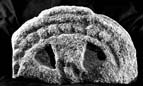
Object type: Part of cross-head [1]
Measurements: H. 21.8 cm (8.5 in); W. 35.4 cm (13.9 in); D. 16 cm (6.3 in)
Stone type: Sandstone, brown (stained), coarse to very coarse grained, quartz granule and small pebble-sized grains common. Quartz cemented. Coarse bedding parallel to face of cross. Upper Carboniferous, local Millstone Grit Group. [G.L.]
Plate numbers in printed volume: Ills. 289-91
Corpus volume reference: Vol 8 p. 157-8
(There may be more views or larger images available for this item. Click on the thumbnail image to view.)
A plate-head with a superimposed ring of type 3, the arms of type E8.
A and C (broad): The head is plain apart from the ring which is ornamented with pellets between flat borders.
B and D (narrow): Broken away
E (top): The plain end of the arm extends above the ring.
Apart from this example at Gargrave, the distribution of this type of circle head, in which the connecting ring appears to overlie the arms that extend like ears beyond the ring, is on the west coast between Cumbria and north Wales, with some outliers in Cornwall (Bailey and Cramp 1988, 31–2). Bailey noted that the Cumbrian and Cheshire versions have distinct characteristics. Gargrave 5 seems very close to the Cheshire variant as its armpits are not pierced and its ring is decorated with pellets rather than interlace, very similar to examples from St John's, Chester (Bu'lock 1958, fig. III). However, the crested circle links it to the Cumbrian series also: compare Muncaster 1, Cumberland (Bailey and Cramp 1988, ills. 471–5). The westward-leaning, Irish-Norse connections of Gargrave 4 have already been noted. This is the sole example of the type in western Yorkshire, although I have noted that an unpierced ring head, Burnsall 10 (p. 112, Ills. 123– 6), which also has Hiberno-Norse connections, may have been influenced in its proportions by some awareness of this type.
