Select a site alphabetically from the choices shown in the box below. Alternatively, browse sculptural examples using the Forward/Back buttons.
Chapters for this volume, along with copies of original in-text images, are available here.


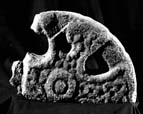
Object type: Part of cross-head [1]
Measurements: H. 30.5 cm (12 in); W. 35.5 cm (14 in); D. 12 cm (4.7 in)
Stone type: Sandstone, brown (stained), coarse grained, quartz with some feldspar, quartz cemented. Upper Carboniferous, local Millstone Grit Group. [G.L.]
Plate numbers in printed volume: Ills. 292-5
Corpus volume reference: Vol 8 p. 158
(There may be more views or larger images available for this item. Click on the thumbnail image to view.)
A ring- head of type 2b with arms of type E8. Both faces are outlined with a plain moulding.
A (broad): The centre is a flattened ringed boss. The upper arm is damaged but seems to have been filled with loose pellets, which also begin the decoration on the left arm, though that continues with the end of an interlacing element. Interlace, possibly a basket plait, fills the right arm.
B and D (narrow) and E (top): Face D is broken away, but the top and face B are dressed plain.
C (broad): The centre, slightly damaged, appears to have been a plain boss. It is encircled by strands which feed into interlace in the upper and side arms — a basket plait in the upper arm and the most complete side arm. The spaces left at the end of the arms are filled by pellets.
Bailey (1978, 178–9) has shown that ring-head crosses, with their strong links to the Celtic church, are introduced into Yorkshire through the arrival of the Norse-Irish, post 920. The pellets and plait-like interlace also indicate Anglo-Scandinavian period taste. This head is not dissimilar to one from Brompton, north Yorkshire (Lang 2001, 70, no. 9, ills. 51–4), but the interlace also looks like a pale reflection of Cumbrian heads such as Gosforth 2 (Bailey and Cramp 1988, ills. 309–10).
