Select a site alphabetically from the choices shown in the box below. Alternatively, browse sculptural examples using the Forward/Back buttons.
Chapters for this volume, along with copies of original in-text images, are available here.


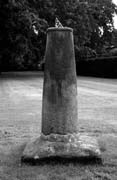
Object type: Part of round-shaft
Measurements:
Shaft: H. 124 cm (315 in); Circumference 140 > 92 cm (55 > 36.25 in).
Socket: L. 83 cm (32.5 in); W. 80 cm (31.5 in); H. 14 > 10 cm (5.5 > 4 in)
Stone type: Pale red (5R 6/2), medium- to coarse-grained, clast-supported sandstone. Grains are sub-angular to sub-rounded and are mostly quartz, but there are a few white feldspar clasts; they range from 0.3 to 2.0 mm, but most are in the range 0.5 to 1.0 mm (coarse-grained). Helsby Sandstone Formation?, Sherwood Sandstone Group, Triassic
Plate numbers in printed volume: Ill. 1
Corpus volume reference: Vol 9 p. 45
(There may be more views or larger images available for this item. Click on the thumbnail image to view.)
The cylindrical shaft is undecorated and topped by a single encircling moulding.
This is almost certainly the lower half of a round-shafted cross of type h (see Chapter V, p. 33). Like Adlington 2 it is characteristic of the Cheshire group of round-shafts — which have a marked concentration in Prestbury parish — in not being associated with an ecclesiastical site. Adlington, along with Macclesfield, first emerges into documented history in the Domesday record as one of the two estates of Earl Edwin (later Earl Hugh) which formed the focus of the impoverished Hamestan hundred. At that date the evidence suggests that the 'estate consisted of a group of manorial tenancies intermingled with extensive comital woodlands, described as eleven leagues by two' (Higham, N. 1993b, 172). The shaft presumably came from some part of this extensive estate. The presence of Adlington 2 (Ills. 2–8), which once stood alongside it in the Hall garden, might suggest the possibility that the two were originally paired monuments like the 'Bow stones', Disley Lyme Handley 1 and 2 (Ills. 162–70), and the shafts set in the double sockets at Disley Church Field, Haslingden and Stretford (Ills. 160–1, 506–7, 649–50). Such a pairing would, however, imply that the mason who converted the garden stone into a sundial removed one of the two encircling mouldings which would be required to match Adlington 2. The form of the mouldings, moreover, differs between the two carvings, with Adlington 2 showing markedly broader and flattened forms of collar. It is therefore likely that the two shafts originated from different parts of the same estate.
The present socket may not be of the same date as the shaft.
