Select a site alphabetically from the choices shown in the box below. Alternatively, browse sculptural examples using the Forward/Back buttons.
Chapters for this volume, along with copies of original in-text images, are available here.


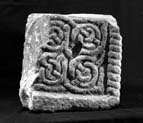
Object type: Part of shaft [1]
Measurements: H. 29.5 cm (11.5 in); W. 31 > 27 cm (12.25 > 10.5 in); D. 23 > 21 cm (9 > 8.25 in)
Stone type: Pale red (5R 6/2), medium- to coarse-grained (0.2 to 0.8 mm, but mostly coarse-grained in the range 0.5 to 0.6 mm), sub-angular to sub-rounded, clast-supported, quartz sandstone. Helsby Sandstone Formation?, Sherwood Sandstone Group, Triassic
Plate numbers in printed volume: Ills. 345-8
Corpus volume reference: Vol 9 p. 133-4
(There may be more views or larger images available for this item. Click on the thumbnail image to view.)
A (broad): At the base is a plain border moulding whilst a cable-moulding arris survives to the right, flanking knotwork of turned pattern A with added outside strand.
B (narrow): A plain lower border moulding and flanking cable mouldings enclose the termination of knotwork of spiralled half pattern A with bar terminal.
C (broad): Traces of worn cable moulding survive to right and left, flanking a simple intertwined double oval.
D (narrow): Plain lower and worn flanking cable-moulding borders enclose fragments of a four-strand plait.
Collingwood (1928, fig. 5) illustrated this shaft as reversed from the above description; the tapering dimensions suggest that he was wrong to do so. The fragment is presumably part of a shaft, though Collingwood'speculated that it might be the neck of a lost cross (ibid., 18). Like other carvings in the Wirral at Neston and Chester St John it uses bold border mouldings. The plain plait and double oval pattern suggest a late Saxon date. The other patterns are ones which, in both half and full versions, do occur in the pre-Viking period at Cundall/Aldborough and Ripon (Lang 2001, ill. 161; Coatsworth 2008, ill. 673) but are also well evidenced in the tenth and eleventh centuries (Cramp 1984, pls. 23.115, 125.694, 189.1048; Bailey and Cramp 1988, ill. 34; Lang 1991, ill. 536; id. 2001, ill. 763).
