Select a site alphabetically from the choices shown in the box below. Alternatively, browse sculptural examples using the Forward/Back buttons.
Chapters for this volume, along with copies of original in-text images, are available here.


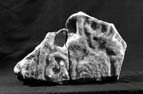
Object type: Part of cross-head in two joining pieces [1]
Measurements: H. 41.5 cm (16.25 in); W. 26. 5 cm (10.5 in); D. 12 cm (4.75 in)
Stone type:
a (smaller fragment): Pale red (5R 6/2), fine- to coarse-grained (0.2 to 0.6 mm, but mostly medium-grained in the range 0.4 to 0.5 mm), sub-angular to sub-rounded, clast-supported, quartz sandstone.
b (larger fragment): Similar, but slightly coarser with grains up to 1.0 mm across, and one angular brown pebble 1 cm in diameter. Helsby Sandstone Formation?, Sherwood Sandstone Group, Triassic
Plate numbers in printed volume: Ills. 349-51
Corpus volume reference: Vol 9 p. 134
(There may be more views or larger images available for this item. Click on the thumbnail image to view.)
A (broad): The fragment consists of two adjoining arms, together with the central area, of a circle-head cross with unpierced spandrels. At the centre is a heavily worn boss whilst two smaller bosses survive in the spandrels. Remains of triquetra decoration fill the arms; this ornament is framed by moulding borders to the spandrels. The most complete arm has the remains of a crossing circle, probably carrying a moulding flanked by framing roll-moulding borders. The 'ears' of this arm protrude fragmentarily beyond the circle.
C (broad): Within a moulding frame there are faint traces of a central boss, together with clearer evidence for two of the spandrel bosses and some indications of triquetra decoration, set within moulding borders, in the arms. No trace of the circle is visible.
Circle-head (see Chapter V, p. 31). Within the circle-head group the combination of unpierced spandrels with armpit bosses and triquetra decoration in the arms is found on West Kirby 3, Hilbre Island 1 and Chester St John 1, 2, 4 and 5, as well as Whitford in north Wales (Ills. 75–84, 89–99, 172–5, 352–3; Nash-Williams 1950, no. 190, pl. XXXIV). Circle decoration formed by a simple moulding recurs on West Kirby 3, Chester St John 2 and at Whitford.
