Select a site alphabetically from the choices shown in the box below. Alternatively, browse sculptural examples using the Forward/Back buttons.
Chapters for this volume, along with copies of original in-text images, are available here.


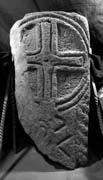
Object type: Slab
Measurements: H. 91 cm (35.75 in); W. 50 cm (19.75 in); D. 13 cm (5 in)
Stone type: Pale red (10R 6/2), fine- to coarse-grained (0.2 to 0.6 mm, but mostly medium-grained in the range 0.4 to 0.5 mm), sub-angular to sub-rounded, clast-supported, quartz sandstone. Helsby Sandstone Formation?, Sherwood Sandstone Group, Triassic
Plate numbers in printed volume: Ill. 388
Corpus volume reference: Vol 9 p. 145
(There may be more views or larger images available for this item. Click on the thumbnail image to view.)
The only surviving face shows the upper part of a cross-slab with one bold cable-moulding border surviving to the right below the cross-head. The cross, type B9 with wide curved armpits, is carved in flat relief with an off-centre drilled hole. Its shape is further defined by an outline moulding and the whole cross is surrounded by a double circular moulding. Below, misleadingly drawn by Collingwood, are two chevrons set one below the other and facing in opposite directions. To the left are the remains of a circular form. There are possible traces of blue paint.
Appendix A item (stones dating from Saxo-Norman overlap period or of uncertain date)
Like many Wirral carvings this carries a bold cabled moulding. The drilled hole could have carried a jewel, decorative glass or paste, as on Lancaster St Mary 1 and many of the heads from Chester St John (see Bailey 1996a, 7–8, 122–3; id. 1996b; id. 2003, 227–9).
Apart from the corded arris, one could argue for a late eleventh-/early twelfth-century date. The incised chevrons and circular form below the cross are characteristic of the decorative motifs of Norman date which Butler (1964) classed as 'Early Geometric' and which have been further studied by Ryder (2003, 111–12). Among the published material from Northumberland and Cumbria there are numerous parallels for this kind of decoration, particular interest attaching to carvings from the cemetery at Mitford castle which pre-date the twelfth-century chapel, and a slab found in a late eleventh-century context in excavations at Newcastle castle (Ryder 2002, 83, 88, figs. 8, 14). Analogous forms, all dated to the early post-Conquest period, can be found in Cumbria at Egremont and Cross Canonby, and in Co. Durham and Yorkshire at Pittington and Forcett (Ryder 2005, 78, 170; Bailey and Cramp 1988, ills. 222–3; Ryder 1985, pl. 47; Lang 2001, ill. 1140). On balance, an eleventh-century date seems the most likely for this West Kirkby piece.
