Select a site alphabetically from the choices shown in the box below. Alternatively, browse sculptural examples using the Forward/Back buttons.
Chapters for this volume, along with copies of original in-text images, are available here.


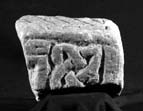
Object type: Fragment of recumbent slab or hogback [1]
Measurements: L. 20 cm (8 in); W. 20.5 cm (8.25 in); H. 16 cm (6.25 in)
Stone type: Pale red (5R 6/2), fine- to coarse-grained (0.2 to 0.6 mm), sub-angular to sub-rounded, clast-supported, quartz sandstone. Helsby Sandstone Formation?, Sherwood Sandstone Group, Triassic
Plate numbers in printed volume: Ills. 359-61
Corpus volume reference: Vol 9 p. 136
(There may be more views or larger images available for this item. Click on the thumbnail image to view.)
A (side): The termination of a vertical panel of four-strand plait or knotwork is surrounded to the left and above by a plain flat border, and to the right by a broader flat-band moulding. Running into this panel in the upper left is a narrow horizontal band of step pattern bordered laterally by a plain border. These two decorative panels seem to frame a central sunken panel.
E (top): Set at a slight angle to face A and separated from it by a rather flat moulding border, is the sloping top of the slab. The remains of a panel carry incised diamond shapes.
Collingwood's discussion of this piece argued that it was part of a cross-shaft with a deeply-cut framed panel on face A (Collingwood 1928, 17); Nunnington 1 in Yorkshire would provide a parallel for the elaborate framing he seems to have envisaged (Lang 1991, ill. 699). Given the angle between the two surviving faces, however, the fragment restores best as a coped slab (or possibly even a hogback) with flanking side-panel on the vertical 'wall' and a low-pitched roof, whose tegulation is represented by diamond shapes like that used on the roof of the hogback Gosforth 5 (Bailey and Cramp 1988, ill. 328). This roof decoration finds other Viking-age — or perhaps later — parallels at Birstall, Yorkshire, and Kirkclaugh in south-west Scotland (Collingwood 1915, 145, fig. d; id. 1927a, fig. 226). The step pattern, like the meander pattern which Collingwood (1928) erroneously drew in this position, is an indicator of a Viking-age carving (Bailey 1980, 72).
If this is a hogback then it adds a fifth to the examples attested elsewhere in the region. Its low-pitched roof would be paralleled in the examples at Lythe or among the Scottish material which Lang classified as derivative/associated monuments (Lang 1974a; id. 2001).
