Select a site alphabetically from the choices shown in the box below. Alternatively, browse sculptural examples using the Forward/Back buttons.
Chapters for this volume, along with copies of original in-text images, are available here.


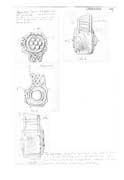
Object type: Part of cross-head [1]
Measurements: H. 27 cm (10.5 in); W. 20 cm (8 in); D. (of arm) 9 cm (3.5 in); (of centre) 14 cm (5.5 in)
Stone type: Collingwood described the stone as 'brown freestone'.
Plate numbers in printed volume: Ills. 433-4
Corpus volume reference: Vol 9 p. 169-70
(There may be more views or larger images available for this item. Click on the thumbnail image to view.)
The only record of this carving is contained in the W. G. Collingwood papers in the Sackler Library, University of Oxford (MSS GB 479, Collingwood). Collingwood's notes show that he had been made aware of the existence of this sculpture in 1912 by Mrs Alice Johnson of Lancaster. It was then in the possession of Major Marton at Capernwray Hall. A later letter among the same papers record arrangements for Collingwood to draw the sculpture in 1915. Collingwood's 1912 note claims the stone as 'from Lancaster', an attribution seemingly based upon the fact that Marton was patron of the Lancaster St Mary living. There is now no trace of the carving at Capernwray Hall, which was sold by the Marton family in 1946 and is now owned by the Capernwray Missionary Fellowship.
I am grateful to Julie Cooper, secretary to the Fellowship, for help in trying to trace this piece and also to Dr Matthew Townend for information about the Sackler papers.
(Based on the photographs and drawings in the Sackler Collingwood papers)
Fragmentary cross-head of type 9 or 10
A (broad): At the centre of the head is a circular cable moulding surrounding a group of seven flat-topped bosses. Fine-line interlace, of turned pattern B type, survives in the upper arm, and there are also traces of interlace in the fragmentary transverse arms; all arms are flanked by a roll-moulding border.
B (narrow): On the upper arm, within a roll-moulding border, are two raised horizontal mouldings.
C (broad): At the centre of the head are two concentric circular mouldings surrounding a flat boss; the outer circle was cabled. There are traces of fine-line interlace, turned pattern B, in the upper arm, and traces of interlace in the fragmentary transverse arms; all are flanked by a roll-moulding border.
D (narrow): On the upper arm, within a roll-moulding border, are three raised horizontal mouldings, the upper two set close together.
There is a strong possibility that this stone originally came from Lancaster; it is certainly ornamentally linked to other Lune valley carvings of the pre-Viking period. Thus, the cluster of seven encircled bosses is found again in the immediate area on Heysham 3 and Gressingham 3 (Ills. 472, 513); the discussion of this motif under Heysham 3 shows that it carried eschatological significance (p. 200). The horizontal mouldings on the narrow faces recur again on Gressingham 3 and can also be found on Hornby 2 and Lancaster St Mary 2 (Ills. 473, 475, 555–6, 570, 572).
