Select a site alphabetically from the choices shown in the box below. Alternatively, browse sculptural examples using the Forward/Back buttons.
Chapters for this volume, along with copies of original in-text images, are available here.


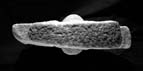
Object type: Cross-head and part of -shaft [1]
Measurements: H. 75 cm (29.5 in); W. transverse arms 40.5 cm (16 in); shaft 21 > 19 cm (8.25 > 7.5 in); D. 12 cm (4.75 in)
Stone type: Greyish orange-pink (5YR 7/2), poorly sorted, medium-grained (0.3 mm) to very coarse-grained (1.5 mm), but mostly coarse-grained in the range 0.5 to 0.9 mm), angular to sub-angular, clast-supported, quartz sandstone. Millstone Grit Group, Carboniferous
Plate numbers in printed volume: Ills. 70-4
Corpus volume reference: Vol 9 p. 60-2
(There may be more views or larger images available for this item. Click on the thumbnail image to view.)
There are conflicting accounts of the circumstances of the discovery of both this stone and the associated Cheadle 2. One version claims that it was found, at an unknown date, during church restoration (Browne 1887b, 151). More authoritative is the narrative given by Earwaker (1877–80, I, 185) who dates the discovery to 1875 when 'some workmen engaged in a large brickfield opposite the Conisland Hospital unearthed the remains of one, if not more, stone crosses. These were left in the field, and would probably have been broken up, had they not been noticed by the late Mrs Bangay, the wife of Dr Bangay of Cheadle, who had them removed to her husband's house.' Earwaker locates the field as that marked 'Brickfield' No. 54 on the 1872 Ordnance Survey map. In 1919 Phelps attempted to summarise both the details of the discovery and the later history of the cross in a paper which included extracts from a letter written by Dr Bangay to the Manchester City News. This credits the doctor, and not his wife, with the discovery and adds that the stones were 'at a shallow depth'. Bangay is described as setting them to one side and only collecting them some time later, when he erected them on the lawn of his Cheadle house; it was here that Phelps claims that they were examined and sketched by Earwaker (see Earwaker 1877–80, I, fig. on 186). Phelps then states that, when Bangay left Cheadle, he took the cross (here Cheadle 1) to his wife's mother's house with the intention of placing it over his wife's grave in 'a village churchyard' about two miles from York. There were problems about this proposal and the sculpture was sent for safe keeping to York Museum by Bangay's mother-in-law, Mrs Brown. Various unsuccessful attempts were made subsequently to restore it to Cheadle.
These accounts can be further supplemented by information published by Moss (1894, 7–8), who described the site of discovery as 'the corner of a field perhaps 300 yards west or slightly to the north of west of the tower of the church and on the opposite high bank of the little river'. Moss, however, was less positive about Dr Bangay's involvement, asserting that the stones had first been recognised by 'the well-known local antiquary, Mr Bailey, who made them out to be two crosses' and that Bangay had subsequently paid the men and removed the more complete cross; 'the other and much older cross was imperfect; it also was taken away with what was probably an upright stone shaft'.
The claim that more than one carving was discovered is supported by Earwaker: 'With them the upper part of an upright stone shaft was found, exactly similar in character' to the shafts which had recently been removed to Macclesfield Park (here Sutton Ridge Hall 1–3: Earwaker 1877–80, I, 185). Bangay denied that any other shaft had been seen or removed by him (Phelps 1919, 108–9).
Cross-head, type E10 with curved and fan-shaped terminals. The decoration was worked with a punch, the stone still incorporating hard pebbles. There are traces of red paint in crevices on all faces.
A (broad): Both head and shaft are surrounded by a continuous roll-moulding border; the shaft is separated from the head by an arched moulding which reaches into the lower arm. At the centre of the head is a boss, some 2.5 cm (1 in) high, surrounded by a low ring. Smaller bosses are set in each of the arms. The shaft is divided vertically by a Latin cross whose upper arm is forked (with another V-shaped moulding within that). This forked element is not set centrally and sprouts an angular pelta to the left. Two runs of irregular scroll flank the cross-shaft.
B (narrow): The shaft is bordered by lateral roll-mouldings within which is irregular and angular ?scroll-work carved in low relief.
C (broad): As on face A, there is a continuous roll-moulding border round both head and shaft, with an arched moulding defining the junction between the two. A raised boss with drilled hole, 3 cm (1.25 in) high, is at the centre of the head, surrounded by a low ring. Further smaller bosses, not always accurately positioned, are set in each of the arms. The shaft is filled with an incised form of disjointed and irregular scroll (spiral-scroll) whose strands evolve into recumbent S and swastika shapes.
D (narrow): Two non-connected elements of a meander pattern decorate the shaft.
The fan-shaped head is typical of a group of such cross-heads from the Pennines area of western Yorkshire and eastern Lancashire and Cheshire (see Chapter V, p. 33). Cheadle, however, combines this type of head with shaft panelling that terminates in a curved border set within the lower arm of the cross. This combination is very closely paralleled on fan-armed ring-heads at Disley Lyme Hall 1 and 2 — though there the top of the shaft panel is more pointed — and similar arching within the lower arm is found at Rainow 1 and on Staffordshire shafts at Leek and Ilam (Ills. 131, 137, 139–41, 240; Brown, G. 1937, pls. XCVIII and C). All of these parallels are on round-shafted crosses of type g/h and suggest that the Cheadle carving is not only of Viking-age date but that, in its original form, it had a cylindrical shaft below the surviving section (see Chapter V, pp. 33–4). The cylindrical column from the now-lost Cheadle 2 may thus have formed part of the same monument. If this reconstruction is correct then it follows that the Cheadle cross provides another example of a round-shaft whose original provenance did not lie in a churchyard (see Chapter V, p. 36).
The bold ring-encircled boss is a familiar motif in the region. Surprisingly, however, the simple arrangement of five bosses on both broad faces of the head is quite rare in both Northumbria and northern Mercia. To the east of the Pennines it can be found on a slab from Escomb, Co. Durham, a head from North Frodingham in Yorkshire and in another form at Elton Moor in Derbyshire (Cramp 1984, pl. 55.271; Lang 1991, ill. 695; Sharpe 2002, 110), but to the west the only other examples are on Bolton le Moors 1 and Winwick 1, together with the version possibly echoed on the Greasby iron cross (Ills. 409, 713, 738). In both Man and Scotland there are but five examples (Kermode 1907, pl. XV; Allen and Anderson 1903, iii, fig. 363; Fisher 2001, figs. 23–5). In Ireland however it is a popular form of head decoration (Harbison 1992, ii, figs. 15, 21, 26, 152, 158, 269, 318, 387, 392, 447, 562, 566, 567, 635, 637; Herity 1989, fig. 6); it also has metalwork representation in the Lough Kinsale shrine (Kelly, E. 1993, fig. 20.1). It is thus at least possible that the motif owes something to an Irish ancestry. The presence of five bosses — presumably originally painted — is potentially symbolic of Christ's wounds (see Lancaster St Mary 9, p. 228), though the number five carried multiple symbolic meanings to early medieval writers (Ó Carragáin 1988, 16–19; Walsh 1990–1, iii, 485; Henderson, I. 1993, 215; O'Reilly 2001, 37–8). The drilled hole in the central boss on face C probably acted as the setting for a decorative attachment; similar holes are found on Hilbre Island 1 and Chester St John 2 and 6 as well as in more elaborate form on Lancaster St Mary 1 (Ills. 81, 83, 100–1, 172, 562).
The shaft ornament is relatively crude. The incised spiralling forms of face C are elsewhere a mark of late carvings in Yorkshire and Cumbria (Lang 2001, ill. 355; Coatsworth 2008, ills. 426, 444, 538–40; Bailey and Cramp 1988, ills. 384–7). The cruciform division of face A is not a familiar device, though a late shaft from Lastingham has a vertical moulding separating ornament of similar 'rustic' appearance (Lang 1991, ills. 578, 580). The V-shaped motif on the upper arm might perhaps be intended to allude to Christ's head and thus perhaps to the 'face-cross' Crucifixion forms discussed under Bromborough 5 (p. 55); a cross-slab from Cladh a'Bhile in western Scotland provides a somewhat remote parallel elaboration (Fisher 2001, fig. 4, K11). Alternatively, and more likely, the forms above the horizontal bar should be seen as a branching type of cruciform tree, with foliate offshoot to the left. This concept, which can also be found on a shaft from Kirkby Wharfe in Yorkshire and the Romsey crucifixion plaque (Coatsworth 2008, ill. 440; Tweddle et al. 1995, ill. 453), draws on the symbolic equation of cross with tree which finds powerful literary expression in the allusive language of the Dream of the Rood and, earlier, of Venantius Fortunatus' Pange Lingua: 'O crux fidelis, inter omnes arbor una nobilis' (Bailey 1980, 146–8).
