Select a site alphabetically from the choices shown in the box below. Alternatively, browse sculptural examples using the Forward/Back buttons.
Chapters for this volume, along with copies of original in-text images, are available here.


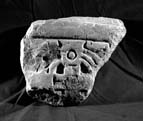
Object type: Part of slab
Measurements: H. 21.5 cm (8.5 in); W. 24 cm (9.5 in); D. 8 cm (3.25 in)
Stone type: Pale red (5R 6/2), medium- to coarse-grained (0.3 to 0.6 mm, but mostly medium-grained between 0.4 and 0.5 mm), sub-angular to sub-rounded, clast-supported, quartz sandstone. Chester Pebble Beds Formation?, Sherwood Sandstone Group, Triassic
Plate numbers in printed volume: Ills. 115-16
Corpus volume reference: Vol 9 p. 70
(There may be more views or larger images available for this item. Click on the thumbnail image to view.)
Upper part of slab, including broad flat border moulding and part of the right border; decoration in low relief on one face only.
A (broad): Beneath the border is a ring-headed cross with wedge-shaped arms and a flat boss, formed by an incised circle, at the centre; only the upper arm survives intact and this carries a flat boss. The ring, which is not continuous, is formed by three parallel mouldings and there is a small boss on the outer moulding where it meets the cross-arm. The upper and left arms carry an incised T (tau cross) whose stem touches the central boss.
E (top): Plain
This little slab was clearly elaborately decorated, the small boss on the ring giving the appearance of a metalwork appliqué sheet held down by rivets (compare the Insular cross and reliquary fragments in Webster and Backhouse 1991, nos. 135–8). Ring-headed crosses on slabs are not a familiar pre-Conquest type in northern England; this example may reflect forms more prevalent in Ireland and western Scotland (Lionard 1961; Fisher 2001, 36–8).
