Select a site alphabetically from the choices shown in the box below. Alternatively, browse sculptural examples using the Forward/Back buttons.
Chapters for this volume, along with copies of original in-text images, are available here.


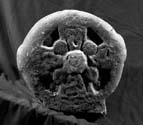
Object type: Cross-head and -shaft in two joining pieces [1]
Measurements:
a (head): H. 43 cm (17 in); W. 45 cm (17.75 in); D. 17.5 cm (7 in)
b (shaft): H. 72 cm (28.5 in); W. 75 > 44 > 36 cm (29.5 > 17.25 > 14 in); D. 25 > 22 cm (9.75 > 8.75 in)
Stone type: Pale red (5R 6/2), medium- to coarse-grained (0.3 to 0.6 mm, but mostly medium-grained between 0.4 and 0.5 mm), sub-angular to sub-rounded, clast-supported, quartz sandstone. A few scattered black ?chert pebbles up to 2 cm across; one looks like a bivalve fragment. Chester Pebble Beds Formation?, Sherwood Sandstone Group, Triassic
Plate numbers in printed volume: Ills. 75-80
Corpus volume reference: Vol 9 p. 62-3
(There may be more views or larger images available for this item. Click on the thumbnail image to view.)
It is now impossible to establish, from printed sources, the exact provenance and date of discovery of the stones from St John's church. Some carvings were clearly found in work carried out in 1861–2 whilst others appear to have been encountered during clearance of the choir area in 1879. The records are as follows:
(a) 1861–2: Parker (1864, 346) and (—) 1864, 400–3 both recorded the discovery of sculpture during excavation and restoration work at St John's church in 1861 and 1862. In December 1861 the Chester Architectural, Archaeological and Historical Society examined various stone fragments discovered recently in work at St John's which 'with two exceptions, had been taken out of the foundations of the old south wall. One of these was the head, almost perfect, of an exceedingly early cross ... The top was of an oval form and both the cross below (which was deeply incised and repeated on both sides) and every portion of the stone, was very elaborately and artistically carved' ((—) 1864, 400–1). 'A flat stone deserved notice, covered with curious interlaced ornament ... [another cross similar to the one previously described] was a short time afterwards discovered in the churchyard, whilst making a drain along the south-eastern boundary of the yard"" ((—) 1864, 402).
b) 1879: Scott (1892, 5) records that 'in 1879 the Duke of Westminster directed that the accumulation of earth, which concealed much of the ruins of the choir, and its chapels, should be removed; in this process there were discovered these beautiful crosses which are now preserved in the Chapter House'.
Rosser (1958, 142) noted the transfer of the sculpture from the Chapter House to the church at some point in the 1950s.
Circle-head with unpierced spandrels and spandrel bosses; set over a short shaft with broad undecorated base
A (broad): The heavily worn cross-head (type B11) has residual arms protruding laterally beyond the line of the circle, but there is no such extension surviving for the upper arm. A large central boss is flanked by flat spandrel bosses which overlie part of the border mouldings of the arms. Within the arms are faint traces of triquetra decoration. There is no clear survival of any decoration on the circle, though there are some possible traces in the lower left of a central moulding flanked by roll-moulding borders. Above the broad base of the shaft the ornament is flanked by a double roll-moulding border. Within this are two panels of ornament. At the top is a worn knotwork pattern; below, enclosed in a double arched frame, is a cluster of flat-topped bosses.
B (narrow): A roll-moulding border is faintly visible around the edge of the circle; the end of the arm has a border moulding enclosing traces of ornament, possibly consisting of rectangular pellets arranged in rows. Above the undecorated base are the remains of a worn meander pattern set within double roll-moulding borders.
C (broad): The relief decoration on the cross-head consists of a central boss, with hollowed centre, surrounded by a ring; immediately adjacent are the spandrel bosses which also appear to consist of a (small) boss surrounded by a ring. This spandrel decoration overlies part of the border mouldings of the arms. Within these arm-frames are triquetra. No decoration survives on the circle. Above the undecorated broad base of the shaft is relief decoration set within a triple border consisting of a double roll moulding and an inner arched frame. The surviving ornament is made up of three horizontal rows of pellets with traces of a median-incised plait above the arch.
D (narrow): No decoration survives apart from roll-moulding borders on the ring. Above the undecorated base of the shaft is a panel framed by double roll-moulding borders containing an irregular type 2 meander pattern.
Circle-head (see Chapter V, pp. 31–3). When re-assembled this cross provides the likely form of many of the monuments whose circle-heads survive at Chester. This assertion is supported by the fact that the other surviving shaft from St John's, Chester 3, is of similar proportions and shares the same broad undecorated lower area, multiple bordering and, indeed, massed bossing of this piece (Ills. 85–8). Outside Chester the circle-headed sculptures at Neston, and perhaps also at West Kirby, had similar squat proportions; these are in marked contrast to the tall shafts of Bromborough and analogous material in north Wales. Though the head is worn, its combination of encircled spandrel bosses and arms decorated with triquetra is shared with Chester St John 2, 4 and (in part) 5, possibly Chester City Walls 1, West Kirby 2 and 3, Hilbre Island 1, and Whitford, Flintshire (Ills. 81–4, 89–93, 95–9, 112–14, 172–5, 349–54; Nash-Williams 1950, no. 190, pl. XXXIV). Like Chester St John 2, West Kirby 3 and Bromborough 3, its rim is decorated by multiple mouldings (Ills. 36, 38, 82, 84, 354). The central boss on face C is hollowed like the centre of Chester St John 2 (ills. 81, 83). Rows of bosses filling the ends of arms recur on Chester St John 2 and are used as shaft decoration on Chester St John 3 (Ills. 82, 84, 85). The use of meander patterns, a popular motif in the Viking period on the sides of shafts, is repeated again on Chester 2 as well as on the three Welsh circle-heads at Penmon, Whitford and Meliden (Ills. 82, 84; Nash-Williams 1950, nos. 38, 190, pls. XXXII, XXXIV; Edwards, N. 1999, fig. 8).
Bu'lock (1959, 6) interpreted the bosses on this shaft, and those on Chester (St John) 3, as representations of roof tegulation, and drew attention to a seeming parallel placing of a building at the bottom of the shaft on the so-called 'Doorty cross' at Kilfenora, Co. Clare (Harbison 1992, ii, fig. 369). The well-known Resurrection iconography of juxtaposed cross and Anastasis structure may, ultimately, lie behind both the Cheshire and Irish motifs (see Werner 1990).
