Select a site alphabetically from the choices shown in the box below. Alternatively, browse sculptural examples using the Forward/Back buttons.
Chapters for this volume, along with copies of original in-text images, are available here.


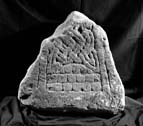
Object type: Part of shaft [1]
Measurements: H. 53 cm (21 in); W. at base 55.5 cm (21.75 in); D. 20 cm (8 in)
Stone type: Pale red (5R 6/2), medium- to coarse-grained (0.3 to 0.6 mm, but mostly medium-grained between 0.4 and 0.5 mm), sub-angular to sub-rounded, clast-supported, quartz sandstone; one angular black ?chert pebbles 7 mm across. Chester Pebble Beds Formation?, Sherwood Sandstone Group, Triassic
Plate numbers in printed volume: Ills. 85-8
Corpus volume reference: Vol 9 p. 64-5
(There may be more views or larger images available for this item. Click on the thumbnail image to view.)
A (broad): This rapidly tapering shaft fragment has a broad undecorated base. The single panel of relief ornament above is flanked laterally by a flat cable-moulding border, well distant from the edge of the stone. Decoration consists of a median-incised eight-strand plait, the two outer turns pointed, set over two horizontal row of flat rectangular bosses. Between the plait and bosses is an arched area on which are traces of a further row of bosses.
B (narrow): Within the broad flat border is a panel decorated with single chevrons, carved in relief and set one above the other.
C (broad): A corded moulding border, set within the lateral arris border, frames a bold median-incised plait of unidentifiable type.
D (narrow): A fragment of median-incised strand survives at the bottom of the shaft; otherwise all other decoration has been worn away.
The ornament on this shaft links it to the circle-head group (see Chapter V, p. 31). It is clearly closely related to Chester St John 1 in both its shape and elements of its decoration: squat and rapidly tapering shaft; broad undecorated base; rows of pellets set under median-incised interlace. The chevrons on face B were planned elsewhere in the group, on Chester St John 6: they also appear on two tenth- or eleventh-century carvings in Yorkshire (York Coppergate 1 and Kirby Sigston 5 — Lang 1991, ills. 334, 335; id. 2001, ill. 382).
