Select a site alphabetically from the choices shown in the box below. Alternatively, browse sculptural examples using the Forward/Back buttons.
Chapters for this volume, along with copies of original in-text images, are available here.


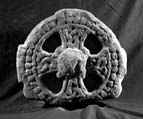
Object type: Part of cross-head [1]
Measurements: H. 40 cm (15.75 in); W. 47 cm (18.5 in); D. 12 cm (5 in)
Stone type: Pale red (5R 6/2), medium- to coarse-grained (0.3 to 0.6 mm, but mostly medium-grained between 0.4 and 0.5 mm), sub-angular to sub-rounded, clast-supported, quartz sandstone. A few well-rounded quartz pebbles up to 8 mm across and a few scattered angular to sub-rounded black chert? pebbles. Chester Pebble Beds Formation?, Sherwood Sandstone Group, Triassic
Plate numbers in printed volume: Ills. 89-94
Corpus volume reference: Vol 9 p. 65-6
(There may be more views or larger images available for this item. Click on the thumbnail image to view.)
Circle-head with deeply cut but unpierced spandrels; cross type B10/11
A (broad): At the centre of the head is a large protruding boss, possibly brambled and surrounded by a ring of small bosses. The adjacent spandrel bosses abut (but do not overlap) the frames of the arm ornament, which consists of triquetra in each arm. The circle carries a run of bosses flanked by roll-moulding borders and there are the remains of a half-cylinder on the external rim below the transom arms.
B (narrow): Between the upper and lateral ears the circle carries a Stafford knot linked to other worn strands set between the border mouldings, whilst the end of the lateral arm has a framed panel containing a fret pattern that consists of four open and linked squares. A half-cylinder moulding occupies the lower segment of the head.
C (broad): Decoration barely survives on this heavily worn face, but there is a large boss at the centre together with bosses set in the spandrels. The arms seem to have carried triquetra set within frames and there are vestigial traces of a run of small bosses, enclosed by framing roll mouldings, on the circle.
D (narrow): The upper curve of the circle carries two Stafford knots whose linking strands are enclosed by a ring. On the end of the arm is a framed panel containing a fret pattern that consists of four open and linked squares. A half-cylinder moulding occupies the lower segment of the head.
This head shares many features with other members of the Chester, Wirral and north Wales group of circle-heads (see Chapter V, p. 31). Like Chester St John 1, 2 and 5, Hilbre Island 1, West Kirby 2 and 3, and Whitford in Flintshire (Ills. 75–84, 95–9, 172–5, 349–54; Nash-Williams 1950, pl. 34) it has non-pierced spandrels with spandrel bosses and triquetra decoration in the arms. Like Chester St John 5, Chester City Walls 1, Bromborough 3, Diserth in Flintshire and Gargrave 5 in Yorkshire (Ills. 35, 37, 95, 97, 112–13; Nash-Williams 1950, no. 185, pl. XXXIII; Coatsworth 2008, ills. 289–90) it has a circle decorated with bosses. There are particularly strong connections to Chester St John 5 in their joint use of four further motifs: a central ring of small bosses; linked Stafford knots with encircled crossing strands; open linked squares; and the presence of half cylinders set low on the head (Ills. 95–9). A variation on this latter motif is found on several shafts in Cornwall where the excrescence is, however, normally shown at the junction of head and shaft (Langdon 1896, 155–61, 170, 180–1; see Chapter V, p. 31, and Foulridge 1, Ills. 723–6). Chester St John 5 also employs the motif of two triquetra with encircled link, which otherwise only occurs within the group at Chester City Walls 1 (Ills. 96, 114). The central ring of bosses recalls metalwork effects like those seen on the Kirkoswald trefoil (Wilson, D. M. 1964, no. 28, pl. XIX).
