Select a site alphabetically from the choices shown in the box below. Alternatively, browse sculptural examples using the Forward/Back buttons.
Chapters for this volume, along with copies of original in-text images, are available here.


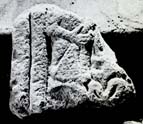
Object type: Fragment of shaft [1]
Measurements: (after (—) 1891b, 115) H. 20.5 cm (9 in); W. 24 cm (10 in); D. 15 cm (8.5 in)
Stone type: Unobtainable
Plate numbers in printed volume: Ills. 109-11
Corpus volume reference: Vol 9 p. 68
(There may be more views or larger images available for this item. Click on the thumbnail image to view.)
(based on photos in British Museum files)
A (broad): A double roll-moulding border on the left flanks some form of (now unidentifiable) figural scene with traces of an arm, hand and drapery to the left.
B (narrow): Lost
C (broad): There are traces of median-incised knotwork with a single lateral roll-moulding frame surviving to the right.
D (narrow): A roll-moulding border frames laterally a run of two-strand plait with a double ring around the two visible inter-sections.
Bu'lock (1959, 6) argued that this stone could be grouped with the other fragments from St John's church as products of the same workshop. This suggestion might find some support from the fact that, like the shafts 1 and 3, the sculptor has used double lateral frames. The presence of figural carving would not be totally out of place in the Chester/Wirral group — Neston 2 and, in Wales, both Penmon and Whitford, all have figural scenes (Ills. 200–5; Nash-Williams 1950, nos. 38, 190, pls. XXXII, XXXIV). Bu'lock's further suggestion that face A showed a Crucifixion seems unlikely on the evidence of the surviving photograph. The knotwork on face D, including a double ring, is a Viking-age motif not otherwise found at Chester.
