Select a site alphabetically from the choices shown in the box below. Alternatively, browse sculptural examples using the Forward/Back buttons.
Chapters for this volume, along with copies of original in-text images, are available here.


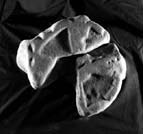
Object type: Part of cross-head in two conjoined pieces [1]
Measurements: H. 40 cm (15.75 in); W. 43.5 cm (17 in); D. 14 > 10 cm (5.5 > 4 in)
Stone type: Pale red (10R 6/2), fine- to coarse-grained (0.2 to 0.6 mm, but mostly medium-grained between 0.3 and 0.5 mm), sub-angular to sub-rounded, clast-supported, quartz sandstone. A few well-rounded quartz pebbles up to 8 mm across and a few scattered angular to sub-rounded black chert? pebbles. Chester Pebble Beds Formation?, Sherwood Sandstone Group, Triassic
Plate numbers in printed volume: Ills. 104-7
Corpus volume reference: Vol 9 p. 67-8
(There may be more views or larger images available for this item. Click on the thumbnail image to view.)
Three quadrants from a plate-head with unpierced spandrels; cross type B/E6
A (broad): Parts of a flat disc survive at the centre of the cross-head. Wedge-shaped arms spring from this, the arm-ends protruding beyond the outer ring, whose roll-moulding borders survive fragmentarily.
B and D (narrow): On the end of the horizontal arms are two framed panels containing mouldings forming St Andrews crosses. On the circle rim above and below are flat rectangular bosses, arranged in horizontal rows of four, set within an arris border.
C (broad): All that remains on this face is a worn upper arm, springing from a flat central disc, which overlies and protrudes beyond the outer border moulding.
The surviving right arm on face A overlies the narrow outer moulding, like Chester (St John) 6, with which it shares a central flat disc (Ills. 100–1); this is therefore not a circle-headed cross. Nevertheless the same taste for massed bosses on the head is found on the circle-heads of Chester St John 1a and 2, as well as the associated shafts of Chester St John 1b and 3 (Ills. 77–9, 82, 84). St Andrews crosses re-appear, in a differing form, on the arms of the circle-head at Diserth in north Wales (Nash-Williams 1950, no. 185, pl. XXXIII).
