Select a site alphabetically from the choices shown in the box below. Alternatively, browse sculptural examples using the Forward/Back buttons.
Chapters for this volume, along with copies of original in-text images, are available here.


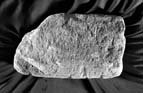
Object type: Part of slab
Measurements: L. 39.5 cm (15.5 in); W. 20 > 14.5 cm (8 > 5.75 in); D. 12.5 cm (5 in)
Stone type: Pale red (10R 6/2), moderately sorted, clast-supported, medium-grained quartz sandstone. The sub-angular to sub-rounded clasts range from 0.3 to 0.7 mm, but are mostly medium-grained in the range 0.4 to 0.5 mm. Chester Pebble Beds Formation?, Sherwood Sandstone Group, Triassic
Plate numbers in printed volume: Ills. 117-20
Corpus volume reference: Vol 9 p. 70-1
(There may be more views or larger images available for this item. Click on the thumbnail image to view.)
A (broad): Part of the border moulding survives to the left. Within this is the corner-angle of an inner border moulding which broadens towards the lower part of the stone. Inside this inner border is a fragment of zoomorphic and interlace ornament. The beast's serpentine body is entangled in interlace of differing widths and is defined by raised borders flanking a single row of rectangular pellets; towards the top of the frame the body seems to broaden and may there have carried a double row of pellets. The border formed by the inner and arris frames is decorated with an angular scroll, whose foliate offshoots terminate in a curl and carry two buds set alongside each other.
B (narrow): Lost
C (broad): Unornamented
D (narrow): Damaged but seemingly unornamented
E (end): Unornamented. In profile this narrow edge curves in towards the base.
The fragment appears to come from the corner of a (presumably recumbent) slab, ornamented on one broad face only. The decoration consisted of a zoomorphic composition set within a frame ornamented with a stripped and somewhat angular scroll. Such decorated frames are rare on slabs, though there are a few examples scattered across the country, at Shaftesbury in Dorset, West Witton in Yorkshire and Monkwearmouth in Co. Durham (Cramp 2006, ill. 89; Lang 2001, ill. 882; Cramp 1984, pl. 121.656). The only stone slab with any form of scroll border appears to be the well-known tenth-century carving from Stepney, London (Tweddle et al. 1995, ill. 354), though ivory panels do provide examples from the eighth century (Webster and Backhouse 1991, nos. 139, 140), and late Saxon southern English manuscripts frequently use this kind of frame (Temple 1976, passim). These parallels underline the ambition of the Chester composition.
The stripped scroll, with a leaf formed from two lobes and an extended curled terminal, is not an early type; it seems to be based upon acanthus forms popular in late Saxon manuscripts and occurs again locally on Chester St John nos. 5 and 9 (Ills. 96, 108). The pelleted body of the serpentine animal (or serpentine extension of a more substantial beast) seems to relate best, as Kendrick (1940, 36) hinted, to the same group of south-western animals which were first isolated as the 'Colerne group' by Cottrill (1935). Within that set there are suggestive parallels at Colerne, Glastonbury, Keynsham, Frome, West Camel, Tenbury Wells and Winchester (Cramp 2006, ills. 222, 246, 274, 348, 433–5, 547; Tweddle et al. 1995, ill. 601). On all of these carvings the bodies of the ribbon beasts are defined by an outline moulding filled with a single or double line of pellets. The dating of these parallels is disputed: Tweddle (1992, 1147–8; id. et al. 1995, 36–40) argued for the late eighth or early ninth centuries, whilst Cramp (2001, 155–8; 2006, 42–8, 71–2) would extend the period of production into the tenth century. If such forms were still in fashion in the south as late as the tenth century then they would chime with tastes in the north which were familiar with Jellinge ornament — in which serpentine pelleted bodies also figured strongly (Wilson and Klindt-Jensen 1966, pls. XXXIII (d), XXXIV (a), XLV; Kermode 1907, nos. 101, 105, 108).
Like Chester Unknown Provenance 2, therefore, this fragment is distinct from the rest of the surviving Chester sculpture in looking to the south for its motifs. Given the seemingly late nature of the scroll, and the undoubted tenth-century date of Unknown Provenance 2 below (which also seems to reflect the 'Colerne school'), a date in the tenth century seems the most likely.
