Select a site alphabetically from the choices shown in the box below. Alternatively, browse sculptural examples using the Forward/Back buttons.
Chapters for this volume, along with copies of original in-text images, are available here.


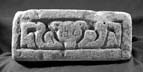
Object type: Incomplete grave-marker
Measurements: H. 32 cm (12.5 in); W. 29 > 28 cm (11.5 > 11 in); D. 12.5 cm (5 in)
Stone type: Moderate reddish orange (10R 6/6), moderately sorted, clast-supported, medium-grained quartz sandstone. The sub-angular to sub-rounded clasts range from fine- to coarse-grained (0.2 to 0.6 mm), but are mostly medium-grained in the range 0.4 to 0.5 mm. Chester Pebble Beds Formation?, Sherwood Sandstone Group, Triassic
Plate numbers in printed volume: Ills. 121-7
Corpus volume reference: Vol 9 p. 71-3
(There may be more views or larger images available for this item. Click on the thumbnail image to view.)
A (broad): The single panel is framed at the sides and top by a flat-band moulding. Within this border is a backward-turning beast with one front and one rear leg, whose rounded heel and arched foot is carefully delineated. The main part of its body and haunch are decorated with two distinct sets of incised hatched lines, all set within an incised border; the neck carries incised zigzag ornament. The animal has a round head with an incised elliptical eye (and pupil within), hollowed ear and curled upper nostril to its open jaw. The tail turns through a right angle to lie along the top of the body and terminates in a pointed and lobed leaf. The front paw ends in three toes. A band issues from the beast's mouth and traverses its body, the crossing of body and strand being encircled with a ring. Beneath the beast's front paw are various incisions which may be part of decoration on the ground below.
B (narrow): A single panel at the top of this face is framed by lateral and upper flat-band moulding borders and by an uncut (and damaged) area below. Within are two Stafford knots (simple pattern E), badly laid out and linked by a long glide.
C (broad): There is a single panel flanked laterally and along the top by a flat-band moulding; the bottom of the panel has a curved border moulding with uncut area below. Within the panel is a ten-strand plait.
D (narrow): Above the uncut area is a single frame, formed by lateral and upper border arrises, containing two Stafford knots linked by a long glide. It is, however, possible that the lower knot involved an encircled twist.
E (top): A single panel, surrounded by flat-band mouldings, contains at the centre an animal mask; this is flanked by scroll stems set out in a recumbent S form, each ending (at both ends) in a foliate motif. The beast has a round face, round jaw, incised round eyes and hollowed round ears.
The stone appears to have been an erect slab, probably originally acting as a grave-marker. Its precise form, with tapering sides and decoration on the top, cannot be exactly paralleled, though slabs with tapering outline and various forms of head (flat, curved, animal-shaped) recur at various dates throughout the pre-Norman sculptural corpus (Sandwich, Whitchurch, Mirfield, York Minster — Tweddle et al. 1995, ills. 151–7, 483–4; Coatsworth 2008, ills. 547–51; Lang 1991, ills. 133–40).
Kendrick described the animal mask on the top of the stone as a 'West Saxon lion head with spray', though without giving specific references to the examples he had in mind. There is no doubt, however, that this Chester form ultimately derives from a motif in which an en-face animal head sprouts foliate forms from its mouth. This type of mask is particularly exploited in manuscript art: it occurs in ninth-century southern (including Mercian) English manuscripts like BL MS Cotton Tiberius C. II and BL MS Royal I. E. VI, or the Barberini and Cerne Gospels (Wilson, D. M. 1984, ill. 111; Alexander 1978, ills. 162, 164, 173; Brown, M. 1996, pls. IIIb, IVa/b; see also Brown, M. 2001), and continues into the repertoire of southern English illumination of the tenth century (Temple 1976, ills. 6, 10, 74, 102, 103, 141, 257, 258, 296). Yet none of these examples have masks, with accompanying foliate forms, which closely resemble this particular form of round-eyed head with its hollow circular ears and rounded mouth. For this combination the closest parallel is offered by the Winchester-style censer cover from London Bridge (Wilson, D. M. 1964, no. 44, pl. XXIV). Kendrick was right therefore to look southwards for the home of this motif, even though the beast-head form as such, without its foliate spray, would be one familiar to those acquainted with the Borre-style repertoire, and types used on tenth-century slabs from York (Richardson, C. 1993, 21, 49–50; Backhouse et al. 1984, no. 133; Lang 1991, ills. 148, 152, 159).
The animal on face A is chronologically more diagnostic, though betraying a complex background. The ring and bar binding across the body is a well-established feature of tenth-century Jellinge/Mammen art. In Scandinavia it can be found on the wooden figures from Jelling (Wilson and Klindt-Jensen 1966, pl. L), whilst there are good examples from England on the British Museum silver shrine fragment and the York Clifford Street cross-slab (Wilson, D. M. 1964, no. 154, pl. XLIV; Lang 1991, ill. 331); Wales also supplies a sculptural example (Nash-Williams 1950, pl. LXV, 12). The nose fold may also derive from a feature of this style, though there are earlier examples of this motif in Insular art. But the basic composition of a non-serpentine profile beast with hollowed ear owes more to an Insular ancestry and, as such, can be compared with the animals on the Viking-period shafts at Aspatria in Cumberland or Nunburnholme in Yorkshire (Bailey and Cramp 1988, ill. 31; Lang 1991, ill. 724). One detail of this animal certainly looks back to ninth-century art: the foliate tail which is found again on manuscript beasts in BL MS Royal I. E. VI and BL MS Cotton Tiberius C. II, or in the metalwork art of the Æthelswyth ring, Pentney brooches or Selkirk finger-ring (Wilson, D. M. 1984, ills. 103, 106, 111, 120; Webster and Backhouse 1991, no. 203). Ninth-century Trewhiddle art also supplies examples of animals with extended tongues (Wilson, D. M. 1964, pl. IV (d); Webster and Backhouse 1991, no. 197). The body hatching may have chimed with Scandinavian traditions (see Wilson and Klindt-Jensen 1966, pls. XXXII–XXXVII) but it is probably significant that the change of hatching direction in the rear haunch more nearly reflects the penchant for block-hatching in animals and birds in south-west Mercia during the ninth century, which is found on non-serpentine beasts like the St Oswald's Priory, Gloucester and Acton Beauchamp shafts and the Cropthorne cross-head (Webster and Backhouse 1991, fig. 25 and no. 209; Cramp 1977, fig. 61d: in general, see Tweddle 1992, 1146–8; Cramp 2001, 157–8; id. 2006, 44–6).
In summary this is a tenth-century piece, betraying the impact of the Jellinge style but in most of its decorative features looking back to the art of the ninth century, and perhaps specifically to work of ninth-century western and south-western Mercia.
