Select a site alphabetically from the choices shown in the box below. Alternatively, browse sculptural examples using the Forward/Back buttons.
Chapters for this volume, along with copies of original in-text images, are available here.


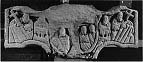
Object type: Part of cross-head [1]
Measurements: H. 34.5 cm (13.25 in); W. 84.5 cm (33.25 in); D. 16 cm (6.25 in)
Stone type: Coarse-grained, massive yellow/grey sandstone (same as no. 5)
Plate numbers in printed volume: Pl. 45.209-212
Corpus volume reference: Vol 1 p. 69-70
(There may be more views or larger images available for this item. Click on the thumbnail image to view.)
Only the horizontal arms of the cross-head survive. Head, type D11, is surrounded by a flat-band moulding on all faces.
A (broad): In the centre is a roll moulding surrounding a cross from which the figure of the crucified has been obliterated save for his left hand. Part of the body survives on a separate fragment (Coatsworth 1978a, pl. 2A). Below the arms of the cross are the remains of four frontal figures, the two nearest to the circular frame being squeezed into it. They are all swathed in pleated robes and have the same head types as the figures on 5 and 7. The figures on the cross-arms who hold shafted crosses and books are identical with those on face B of 5, except that on the right arm (where this portion survives) the relief feature between the inner figure and the roundel seems to be a bar rather than a triangle.
B (narrow): Two registers of closed circuit pattern D with bar terminals on the end of the arm are enclosed in a roll moulding.
C (broad): In the central roundel, enclosed in a roll moulding, is a baptism scene, as on 5, with the variation that the figure on the left has a halo and is shown with hands clasped across its stomach. Between it and the central figure is a free roundel. The cross-arms have the same pairs of frontal figures as face A; triangular features in relief lie between the inner figure and the roundel.
D (narrow): Two registers of pattern D with bar terminals on the end of the arm are enclosed in a roll moulding. The upper register is closed circuit.
See no. 7.
