Select a site alphabetically from the choices shown in the box below. Alternatively, browse sculptural examples using the Forward/Back buttons.
Chapters for this volume, along with copies of original in-text images, are available here.


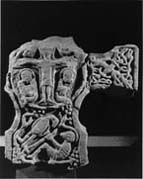
Object type: Part of cross-head [1]
Measurements: H. 55.2 cm (21.75 in); W. 52 cm (20.5 in); D. 16 cm (6 in)
Stone type: Coarse-grained, massive yellow/grey sandstone (same as no. 5)
Plate numbers in printed volume: Pl. 46.213-216
Corpus volume reference: Vol 1 p. 70-71
(There may be more views or larger images available for this item. Click on the thumbnail image to view.)
Head, type B11. The broad faces are surrounded by a flat-band moulding.
A (broad): In the centre are the remains of a circular roll moulding framing a Crucifixion scene. The cross appears to be type D11. The figure of Christ is rigidly frontal, his head upright and filling the upper arm, his arms outstretched straight along the horizontal arms of the cross, his feet out-turned at the base of the cross. He wears a knee-length tunic. To the right of his head is an angular crescent in relief, to the left a side-facing head in relief. Below the cross-arms are two three-quarter length frontal figures. Both have haloes and hold books. On the horizontal arm is a pair of crossed ribbon animals with canine heads. They have blunt jaws, slit mouths, oval eyes and ear extensions which cross over their bodies and front legs and seem to join their tails. On the lower arm are the figures of a man and a bird. The man's body is depicted in profile but his head is frontal; the bird's body is frontal but its head in profile. The bird is standing on what appear to be human legs and feet and is looking down at the man who is bent in the curve of a branch and clasping the trunk of a tree which stands between them. His head is bent back and he wears a short pleated garment.
B (narrow): On upper arm complete pattern B with a fret terminal. On lower arm a closed circuit pattern in which two concentric rings are linked with four loops. The effect is of a pattern D. Both panels are enclosed in single roll mouldings.
C (broad): In the centre is a baptism scene of the same basic design as on 5 and 6, with the same attendant figures on the left cross-arm. In the lower arm is a leonine creature enmeshed by a serpent. The serpent's head is biting at the back of the leonine creature's neck and its body is coiled between the beast's front legs, and knotted with its tail. The beast's front leg is raised. It has a three-toed foot and there is a twisted device on its body.
D (narrow): Upper arm broken off. On lower arm ring-knot like those on 5D with roll mouldings on either side.
Crosses 5-7 are all very closely linked in form and ornament. Recently Bailey (1978, figs. 9.6-9.9) has shown that the figures of the ecclesiastics with crosses and books have been constructed with the same stencils or block matrices. It is possible that the matrix was derived from 5 which is the finest carving. All three have a scene which is most reasonably interpreted as a baptism, although it is not impossible, in view of the apparent age of the bending figure, that it could be an ordination scene. This would explain the attendant figures of ecclesiastics and it is as well to remember that ordination is a sacrament as well as baptism. The scene has also been interpreted as the sacrifice of Isaac, which was certainly seen as a prototype for the Crucifixion, but the instrument held above the kneeling figure does not look like a weapon.
Coatsworth (1978a, 88), in the most recent and most detailed discussion of these cross-heads, accepts the baptism scene as that of Christ. She sees the long-handled object which the central figure holds as a crook, such as John the Baptist sometimes holds in this scene. I prefer to see it as a ladle or spoon which is used to pour the water or oil of baptism. The bird above the baptism scene in 5 and 7 has been interpreted as the Holy Spirit in the guise of a dove. Coatsworth convincingly identifies the bird as an eagle and argues that with the symbols of the sun and moon on either side of its head it could symbolize Christ in his Incarnation and Ascension. She sees this as carrying out the theme of revelation which the Agnus Dei provides, when John the Baptist says (John 1,29): `Behold the Lamb of God. Behold him who taketh away the sins of the world.' The depiction of the Lamb on face A of 5 is clearly apocalyptic, surrounded as it seems to be by the symbols of the Evangelists (Cramp 1978b, 123) and with the sun and moon appearing simultaneously in the sky. The Lamb places his foot on what seems to be the book with seven seals mentioned in Revelation 5,1. Coatsworth (1978a, 86) compares the circle (possibly the Host) and the shafted cross, which are also shown with the Lamb, with an eleventh-century architectural relief from France (Schiller 1972, pl. 305). This Durham depiction has also been compared with the late Saxon Agnus Dei issue of coinage (Dolley 1971, 343).
The Crucifixion scene which appears instead of the Lamb on 6 and 7 has also been extensively discussed (Coatsworth 1978a). The four figures beneath the cross-arms on 6 are tentatively interpreted by her as Evangelist figures, or witnesses. The two figures under the cross-arms on 7, one with a book and the other with a scroll, both possibly haloed, are convincingly interpreted as Mary and John. The lack of haloes on some figures on these crosses is an odd feature. In the Crucifixion scene Christ and the figures below are shown with them, and so possibly is the symbol of St Matthew on face A of 5, but the Lamb is without halo, and, unless the curious border which surrounds the winged beast on the right arm of 5 is a mandorla, the other apocalyptic beast symbols of the apostles are not shown with this feature. More surprisingly, if the bowed figure in the sacramental scene is Christ, he is also without a halo. Its absence supports the view that this scene could represent baptism or ordination.
The man and bird in the plant-scroll, as on earlier crosses, probably symbolize the Eucharist, and the bound beasts could be the powers of evil. However, beast panels (like vine-scrolls) have a long tradition in Northumbrian sculpture, and perhaps their interpretation should not be pressed too far. These crosses clearly seem to be linked with a revival of liturgical and doctrinal interest in northern sculpture, and their style of cutting also represents something new; they are the only group with ecclesiastical figures. However, the interlace repertoire can all be found on the St Oswald crosses (Durham 1-3) and the Durham grave-cover (no. 11). From the Durham centre the style seems to have spread out to Hart and Ovingham, Tynemouth and Aycliffe. It seems to me that a possible period for the adoption of these new ideas is the episcopate of Eadmund between 1021 and 1042. He seems to have introduced new ideas and at least one person from a monastic house elsewhere (Symeon 1867, chap. 41), as well as having had a long and successful episcopate (Introduction, p. 33).
