Select a site alphabetically from the choices shown in the box below. Alternatively, browse sculptural examples using the Forward/Back buttons.
Chapters for this volume, along with copies of original in-text images, are available here.


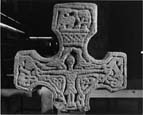
Object type: Complete cross-head [1]
Measurements: H. 61.5 cm (24.5 in); W. 67 cm (26.25 in); D. 15.2 cm (6 in)
Stone type: Coarse-grained, massive yellow sandstone
Plate numbers in printed volume: Pl. 47.217-220; See no 5
Corpus volume reference: Vol 1 p. 71-72
(There may be more views or larger images available for this item. Click on the thumbnail image to view.)
Head, type C11, although the extra height of the top upright arm verges towards C10. On the broad faces the head is edged with a flat-band moulding which is median-incised.
A (broad): In the centre of the head is a frontal figure with arms rigidly outstretched. His feet are supported on a foot-rest or suppedaneum. His hands are extended with the thumbs upright. He wears a long-sleeved garment, tightly fitting at the top, and a short belted tunic. His hands lie under the front legs of two quadrupeds. Their heads are turned back to bite their tails. They have canine heads with pointed ears and round eyes. Their bodies are lightly outlined. Their feet are three-toed. Their feet join triangular mouldings with twisted terminals which enclose a triquetra knot and fill the spaces under the arms of the figure. The front legs of the animals touch the backs or tails of two crouching confronted winged creatures, whose front legs are folded back on the shoulder of the central figure and whose heads touch above his head. Dividing them from a backward-looking quadruped in the upper arm is a panel of four-strand plain plait enclosed in a roll moulding.
B (narrow): On the edges of the upper and horizontal arms are two linked pattern E elements enclosed in grooved mouldings.
C (broad): In the centre of the head enclosed in an irregular circular roll moulding is a quadruped with its front leg raised. It has long jaws, a pointed ear, a long limp tail and its body is patterned by a series of concentric incisions. Behind it is a shafted cross (head, type A6), which is set in a rectangular base with grooved mouldings (as on 6). Above the back of the animal is a circular feature with a small central depression. On the horizontal arms are two registers of simple pattern E with a space-filling pellet between the outer pairs. In the upper arm is a composition of two canines. Their tails join in a knot; their ear extensions cross their bodies and interlink their pointed front legs, while their back legs coil up and over their bodies. The details of their heads are indistinct. In what is left of the lower arm is the upper half of a composition in which an animal with a canine head struggles in the coils of a snake whose jaws grip its ear.
D (narrow): At the edge of the upper arm is a motif of two closed circuit loops. Below are two registers of simple pattern E. Both panels are enclosed in grooved mouldings.
This head differs from the cross-heads already discussed both in the nature of its stone and in the more irregular and shallow carving. Obviously however it has some features in common with the others. The Lamb on face C is obviously derived from face C of 5 or a common model. It is more crudely depicted and the front leg is awkwardly extended and bent, but not over a book. The cross behind the animal has a similar base to that on 5, but the head with the arms tapering to the centre is a late type popular on grave-markers. The circle, whatever its interpretation, is here above the back of the animal. The serpent and animal enmeshed in its coils is very close in composition to that on face C of 7. However, the animal has become the rather anonymous canine which one finds at Lindisfarne (no. 7) and on Chester-le-Street 1. Animals are very prominent on this piece, not only as terminals of interlace above the Lamb, but also at the end of each arm surrounding the figure on face A. Backward-looking quadrupeds with double-incised outlined bodies have a long tradition in Anglo-Saxon art. Coatsworth, 1978a, sees the figure as possibly Daniel rather than Christ. However, figures of Christ with arms extended, but without a cross behind other than the cross-head itself, are known elsewhere in northern Britain in the late Saxon period. It is possible that this was meant to represent a Crucifixion scene and possibly also Christ as Lord of the animals, holding the bound powers of evil nature at bay, whilst on either side of his head two winged creatures kneel prayerfully. The importance of Christ as subduer of the beasts, a new Daniel or a new Týr, seems to have been stressed in the tenth/eleventh century (see Sockburn 21 and Tynemouth 2). The style of the figure is similar to Tynemouth 2 and Ovingham 1. Possibly also the winged creatures above his shoulders may be compared with those figures with birds on their shoulders, such as Leeds (Bailey 1980, pl. 4) or Kirklevington, Yorkshire (ibid., pl. 57); cf. Billingham 1.
