Select a site alphabetically from the choices shown in the box below. Alternatively, browse sculptural examples using the Forward/Back buttons.
Chapters for this volume, along with copies of original in-text images, are available here.


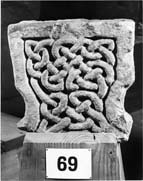
Object type: Cross-arm [1]
Measurements: H. or W. 19 cm (7.5 in); W. or H. 20.5 cm (8 in); D. 7.6 cm (3 in)
Stone type: Medium-grained yellow sandstone
Plate numbers in printed volume: Pl. 48.221-225
Corpus volume reference: Vol 1 p. 72
(There may be more views or larger images available for this item. Click on the thumbnail image to view.)
Head, possibly type A10. The arm is surrounded by a flat-band moulding. It is carved on the two broad faces and the top (or what might have been the end if horizontal). The narrow faces are plain.
A (broad): Part of an irregular ten-cord plait which diminishes to a six-cord.
C (broad): Part of a single closed circuit pattern, in which two circles are crossed by a single strand which loops in each corner.
E (top): Alternating half pattern D.
The interlace patterns are deeply and confidently cut, closely packed and well modelled. This piece is convincingly the work of the carver of the grave-cover, no. 11, and a cross-head from Tynemouth (no. 5), as well as the Hexham shaft (no. 5), are closely linked to it (Adcock 1974, 334-6).
