Select a site alphabetically from the choices shown in the box below. Alternatively, browse sculptural examples using the Forward/Back buttons.
Chapters for this volume, along with copies of original in-text images, are available here.


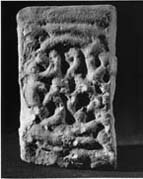
Object type: Cross-arm or architectural fragment [1]
Measurements: H. 21 cm (8.25 in); W. 11.5 cm (4.5 in); D. 12 cm (4.75 in)
Stone type: Fine-grained, massive yellow sandstone
Plate numbers in printed volume: Pl. 48.226-228, 48.230, 48.233
Corpus volume reference: Vol 1 p. 72-73
(There may be more views or larger images available for this item. Click on the thumbnail image to view.)
A (broad): One large ring-knot (closed circuit) pattern C with outside strands and unpinned loops.
B and D (narrow): Broken away.
C (broad): Part of a ring-knot similar to that on A.
E (top): Double free rings with two crossing diagonals and bar terminals.
This piece is possibly the end of a cross-arm but, as it has no curve on top, it might be some form of impost. It is interesting that the plait type and technique have been linked by Adcock (1974, 334-6) to the work of the carver of the Durham grave-cover (no. 11). Similar work is also found at Hart (no. 9).
