Select a site alphabetically from the choices shown in the box below. Alternatively, browse sculptural examples using the Forward/Back buttons.
Chapters for this volume, along with copies of original in-text images, are available here.


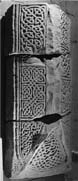
Object type: Part of coped grave-cover, in three joining pieces [1]
Measurements: L. 134.5 cm (53 in); W. 55 cm (21.75 in); D. (end) 17.8 cm (7 in), (centre) 30.5 cm (12 in)
Stone type: Medium-grained, massive yellow sandstone
Plate numbers in printed volume: Pls. 49.234-235, 50.236
Corpus volume reference: Vol 1 p. 73
(There may be more views or larger images available for this item. Click on the thumbnail image to view.)
The ridge consists of the bodies of two ribbon animals, whose necks divide to form a `gabled' end. The heads project into each corner beyond the double roll mouldings framing panels of interlace which decorate the shallow `eaves' of the monument.
A (long): Divided into three panels, two rectangular and one triangular. (i) Three registers of pattern C with outside strands. (ii) Three registers of double-stranded simple pattern E. (iii) An irregular plait, an eight-cord pattern which diminishes to a single pointed loop.
B (short): The interlace panel between the two heads is of an irregular type which is cleverly adapted to fit the triangular shape. It starts at the base as a fourteen-cord pattern and tapers to an unpinned loop at the top with a branching strand. The animal terminal between it and the next triangular panel (Ci) is intact. The beast has a long pointed muzzle and sharply pointed cars which are laid back against its head. It has lightly incised oval eyes.
C (long): (i) The triangular panel on the left is filled with an irregular interlace perfectly adapted to the space. At the widest point it is a ten-cord pattern and drops at regular intervals to a single pointed loop. Then three rectangular panels separated by fine roll mouldings. (ii) A split plait with rather angular diagonal strands and space-filling pellets. (iii) A reversed pair of pattern B registers with an irregular break. (iv) Two registers of pattern C with outside strands.
The vertical faces of the monument are uncarved but are dressed smooth.
Coped grave-covers became widely fashionable in England in the tenth/eleventh century: one from St Denys, York (Kendrick 1949, pl. 63), parallels the type with a central ridge, and a strange outlier from Bexhill, Sussex (Kendrick 1949, pl. 56), divides the gable ends and the panels of the `eaves' in the same way. However, the split plait and the animal ornament may imply some northern influence on the Bexhill piece. The Durham grave-cover is very firmly linked with Northumbrian traditions. The animal-headed terminals are almost identical with those on Sockburn 8, where they enclose Anglo-Scandinavian animal ornament. The irregular panels of interlace with loose loop terminals are also Scandinavian in taste. The cutting is sharp and the strands are well modelled, but not quite as fine as the St Oswald's cross (Durham 1), or earlier Lindisfarne work. The pattern E panel is paralleled on the St Oswald's cross, as well as at Tynemouth (nos. 1 and 3) and Lindisfarne (no. 18), and four interlace types are common to the St Oswald's cross and this piece. Adcock (1974, 328-37) who has discussed it fully sees work of this grave-cover master also at other centres such as Hart (no. 9), Hexham (no. 5) and Gainford (no. 7) and on other stones at Durham. This suggestion is convincing. The precise work of these pieces introduces a new competence into the carvings of the area. Adcock sees this work as having all the hall-marks of a revivalist who understood interlace theory but who used the patterns he could see carved on existing crosses, or irregular patterns which were not dependent on geometric repetition (Introduction, p. 18).
