Select a site alphabetically from the choices shown in the box below. Alternatively, browse sculptural examples using the Forward/Back buttons.
Chapters for this volume, along with copies of original in-text images, are available here.


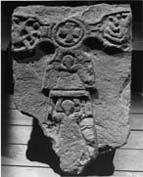
Object type: Grave-cover [1]
Measurements: L. 96 cm (37.75 in); W. 65.3 cm (25.75 in); D. (max.) 10.2 cm (4 in)
Stone type: Flaggy, irregularly bedded yellow sandstone
Plate numbers in printed volume: Pl. 51.241
Corpus volume reference: Vol 1 p. 73-74
(There may be more views or larger images available for this item. Click on the thumbnail image to view.)
Only one face is carved and this is incomplete at the top and bottom.
A (top): A deeply carved cross, type B11, extends for the full width and length of the slab. It is surrounded by a roll moulding. In the centre a circle bears a small relief cross, type B8. On the left horizontal arm is a motif attached to a block-like feature with a large pellet on one side of it. This motif could be an animal with its four legs crossed and touching a block, or it could even be a form of plant-scroll, with the block-like feature its root. On the right horizontal arm is a four-legged creature with a small unidentifiable head and a pellet below the jaws. Below its feet there is a small cross. On the lower arm a figure has been partly cut away. It has a round head, what appear to be wings and a tapering block-like body
The shaft is narrower than the head and was surrounded by a wide flat-band moulding. What survives of the shaft is filled by a figure which has its left arm upraised. It appears to have a heavy halo, a wedge-shaped head, a tapering block-like body, and is possibly winged.
Although there are animals and figures on cross-heads 5 and 7, the style of carving of the figures on this grave-cover is different and more like Aycliffe 1 and Gainford 3. It may be that the beast or beasts on the arms were all meant to be Evangelist symbols; they are too debased to be certain. The block-like feature on the left arm could be a book, so that if they are Evangelist symbols, as on the Ruthwell cross, St John's would be on the upper vertical arm, St Matthew's on the lower, vertical, and Luke's and Mark's on the horizontal. The shape of the cross is like the free-standing cross-heads 5-7, and it is possible that the Evangelist symbols, if such they are, may also have been copied from these more elaborate monuments. This slab is thin enough for use as the cover of a stone coffin. It seems that a variety of burial-markers co-existed in the early eleventh century at Durham.
