Select a site alphabetically from the choices shown in the box below. Alternatively, browse sculptural examples using the Forward/Back buttons.
Chapters for this volume, along with copies of original in-text images, are available here.


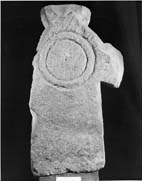
Object type: Part of cruciform grave-marker or gable finial [1]
Measurements: H. 52 cm (20.5 in); W. 28 cm (11 in); D. 10 cm (4 in)
Stone type: Medium-grained yellow sandstone
Plate numbers in printed volume: Pl. 50.237-240
Corpus volume reference: Vol 1 p. 74
(There may be more views or larger images available for this item. Click on the thumbnail image to view.)
The cross-head has very short arms. The centre is so wide that it almost forms a plate between the arms. The angle of the arm-pit is very sharply V-shaped. Only one face is decorated.
A (broad): In the centre of the head are two concentric circles, both with a dot centre.
B–D: Roughly dressed.
The shape of the head, with very short arms and a large circular centre which almost gives the appearance of a plate-head, seems to be late. It could in fact be post-Conquest, and it is impossible to say whether it was a grave-marker or gable finial. The lower portion of the shaft seems to have been dressed back as though to fit a socket. The origin of the decoration seems to be the type of cross with bossed centre surrounded by a heavy roll moulding which is common in the region. For instance Tynemouth 6 and Durham 4 have roll mouldings surrounding a slightly sunken centre. This could have been an intermediate stage towards the flat type of ornament found here.
