Select a site alphabetically from the choices shown in the box below. Alternatively, browse sculptural examples using the Forward/Back buttons.
Chapters for this volume, along with copies of original in-text images, are available here.


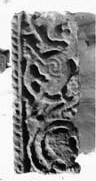
Object type: Part of cross-shaft, in two pieces [1]
Measurements:
Fragment a: H. 61.5 cm (24.2 in); W. 25 cm (9.8 in); D. 18 cm (7.2 in)
Fragment b: H. 51 cm (20.1 in); W. 25.5 cm (10 in); D 18 cm (7.2 in)
Stone type: . Coarse-grained, massive yellow sandstone
Plate numbers in printed volume: Pl. 53.250-255
Corpus volume reference: Vol 1 p. 77
(There may be more views or larger images available for this item. Click on the thumbnail image to view.)
a. A (broad): A panel of inhabited plant-scroll is edged by an outer cable and an inner roll moulding. At the top there appears to be the tail of a creature whose foot is gripped in the jaws of a long necked creature below. Its legs are widely extended, stiffly straddling the coil of the volute. Its head is small and rounded and it has a spiral hip joint. Below is a creature chipped away to the bare outline.
B and C: Broken away.
D (narrow): Part of a fleshy deeply cut plant-scroll is edged by an outer cable and inner roll moulding. The total pattern is not determinable; its nodes are ridged, stems median-incised, and foliage and flower details deeply scooped. Its leaves are pointed and lobed, and there are composite leaf-flowers. Leaves take the place of berry bunches in the organization.
b. A (broad): Part of a worn cable and inner roll moulding surround a plant-scroll which springs from a triangular root grounded on the horizontal moulding. A bird is shown in a frontal position, its neck curving to the right to peck at a berry bunch, which is attached to a stem passing behind its wings and body, while another stem passes over its wings and under its tail. The feathers of the bird are crudely conveyed by grooving and scalloping. Its head is parrot-like and its eye has a backward point.
B and C: Broken away.
D (narrow): A scroll is almost obliterated.
Although the pieces were once reconstructed set opposite to one another, it is possible that they were originally one above the other. This type of scroll reflects the Mercian and Deiran styles which affected Bernicia in the early ninth century, at centres as far away as Norham and near by at Auckland St Andrew. The long curving neck of the bird and its elaborate feather patterns, the stiff long legs of the animal and its spiral joint, can also be paralleled in metalwork such as the Witham pins (Wilson 1964, pl. 18), but the form of the feathers is more like the Aethelwulf ring (ibid., 141-2, pl. 19, 31). Animals with stiffly extended feet in almost horizontal positions can be seen also at Croft and St Peter's, York.
On face D the scooped leaves and leaf-flowers are also a Mercian type which extends northwards as far as Ilkley, Yorkshire, and Kirkby Stephen, Westmorland, but is found in a less developed form here. See also Escomb 3 for a fine early scooped leaf bunch.
