Select a site alphabetically from the choices shown in the box below. Alternatively, browse sculptural examples using the Forward/Back buttons.
Chapters for this volume, along with copies of original in-text images, are available here.


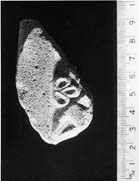
Object type: Socket(?), possibly part of church furnishing [1]
Measurements: H. 7 cm (2.75 in); W. 7 cm (2.75 in); D. 4.3 cm (1.6 in)
Stone type: Limestone(?)
Plate numbers in printed volume: Pl. 54.260-262, 54.265
Corpus volume reference: Vol 1 p. 78
(There may be more views or larger images available for this item. Click on the thumbnail image to view.)
A: Bordered by a broad flat-band moulding are three deeply scooped petals or leaves and part of a scroll.
B: Broken with what may be a socket.
C: Dressed smooth and broken away.
The stone type and the very fine dressing of this stone can be compared with some of the early architectural details from Monkwearmouth (Cramp 1971, 28-9). The petalled flower detached from a scroll is a motif found at Jarrow (no. 24); it may be late seventh century, but continues in popularity in the late eighth to early ninth century, for example at Breedon and Ilkley. It seems possible that this stone was carved as a socket for a light.
