Select a site alphabetically from the choices shown in the box below. Alternatively, browse sculptural examples using the Forward/Back buttons.
Chapters for this volume, along with copies of original in-text images, are available here.


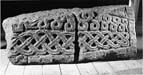
Object type: Incomplete hogback, in two joining pieces [1]
Measurements: L. 117 cm (46 in); W. 26.7 > 20.3 cm (10.5 > 8 in); D. 43.8 cm (17.25 in)
Stone type: Massive yellow gritstone
Plate numbers in printed volume: Pls. 71.353-354, 72.355, 72.357
Corpus volume reference: Vol 1 p. 87-88
(There may be more views or larger images available for this item. Click on the thumbnail image to view.)
Type h – scroll type.
A (long): Although most of the roof has gone, at the top right are the remains of two tegulae, type 2c. Below are two panels of ornament set in a plain frame. (i) Unpinned loop pattern which curves up towards the centre and diminishes in scale towards the ends. (ii) Four-strand median-incised plain plait.
B (end): Dressed smooth with converging frames which form a type of gable.
C (long): Although most of the roof has gone, at the top left are the remains of two tcgulae, type 2b. Below are two panels of ornament set in a plain frame. (i) Running spiral scroll which curves up towards the centre and diminishes in scale from right to left. (ii) Median-incised plait as on A.
D (end): Broken off.
This narrow type of hogback with a wide flat frame which comprises the gable, and with two zones of curving horizontal ornament is, as has been remarked, very like Crathornc, Yorkshire (Haverfield and Greenwell 1899, 109). The running spiral has a wide distribution in the north, being found in Yorkshire (York, Kirkdale and Oswaldkirk); at Penrith, Cumberland, and Appleby, Westmorland: Lang 1967, 287; and at Sockburn (no. 15). Despite the coherent form of the pattern here, it is most probably related to the Anglo-Scandinavian Cumbrian scrolls as at Dearham or Kirkby Stephen, rather than being a direct and early development of the leafless scrolls of the Anglian stones of the late ninth century (for example, Ilkley).
