Select a site alphabetically from the choices shown in the box below. Alternatively, browse sculptural examples using the Forward/Back buttons.
Chapters for this volume, along with copies of original in-text images, are available here.


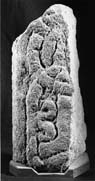
Object type: Part of round-shafted cross or support of reading desk [1]
Measurements: H. 37 cm (14.5 in); W. (incomplete) 17.5 cm (6.9 in); D. (incomplete) 11.5 cm (4.5 in)
Stone type: Coarse-grained, massive yellow sandstone
Plate numbers in printed volume: Pl. 177.940-943
Corpus volume reference: Vol 1 p. 179
(There may be more views or larger images available for this item. Click on the thumbnail image to view.)
Parts of two faces only survive, in picked and grooved technique, divided by a square-sectioned flat-band moulding.
A: At the top is what appears to be a closed circuit pattern with a double ring crossed by a diagonal, which then becomes an outside strand and crosses over another. These enclose a free S-shaped strand.
B and C: Missing.
D: Parts of three closed circuit rings crossed by two diagonals.
It is possible that this piece is not part of a late cross-shaft but part of a piece of church furniture, perhaps the stand for a reading desk. There is a similar fragment at Kirkby Stephen (Collingwood 1927, fig. 15). This fitment would then have to be seen as part of the work of Eilaf who, no doubt, added to the church. In style the nearest parallel to this piece from Hexham itself is cross-head 11, which also has the crudely grooved interlace patterns and the little free curls. This piece seems to reflect the Durham influence of the period c. 1000 (Cramp 1974, 137-8).
