Select a site alphabetically from the choices shown in the box below. Alternatively, browse sculptural examples using the Forward/Back buttons.
Chapters for this volume, along with copies of original in-text images, are available here.


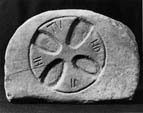
Object type: Round-headed grave-marker, possibly recumbent [1]
Measurements: H. 22.2 cm (8.75 in); W. 31.6 cm (12.25 in); D. 11.5 cm (4.5 in)
Stone type: Fine-/medium-grained sandstone, slightly burnt
Plate numbers in printed volume: Pl. 178.952-953
Corpus volume reference: Vol 1 p. 181-182
(There may be more views or larger images available for this item. Click on the thumbnail image to view.)
The stone is roughly shaped with a rounded top and slightly curved verticals.
A (broad): In the centre is a cross, type E8. The cross has been set out in an incised circle and is at an angle from the top of the stone (the central setting-out hole is still visible). The ground has been chiselled away to form the splayed arms. There is an inscription in seriffed Anglo-Saxon capitals, two letters of which appear on each arm of the cross:
TV II ND II VI II NI
This is presumably an Old English masculine personal name.
B, D and E (narrow sides and top): Roughly dressed.
C (broad): Plain.
Tund- is not known as a name element, but according to Okasha (1971, 80) the name may be a form of the recorded Tondwine. Okasha gives the date of this piece as `eighth to ninth century' and certainly it does appear as though these small round-headed grave-markers, in which the cross is shown in low relief, are a later development than the simple incised group of Lindisfarne or Hartlepool (Introduction, p. 7). In the form of the cross this piece is nearest to Bothal 5 which includes later ornament. It is also similar to those on slabs from Ardwall Isle, nos. 4 and 13 (Thomas 1967, 152-3, 164-5), which have been dated eighth to tenth century. The unique placing of the inscription round the ends of the arms of the cross may be because the inscription is secondary, or merely an attempt to place it on the most prominent surface. If the piece were intended to lie flat, the inscription would have been perfectly readable.
