Select a site alphabetically from the choices shown in the box below. Alternatively, browse sculptural examples using the Forward/Back buttons.
Chapters for this volume, along with copies of original in-text images, are available here.


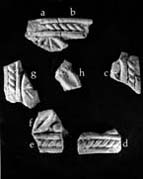
Object type: Eight fragments of ornamental panel
Measurements:
Fragment a L or H: 7.1 cm (2.8 in); W: 5.2 cm (2.1 in); D: 1.5 cm (0.6 in)
Fragment b L or H: 5.6 cm (2.25 in); W: 3.4 cm (1 .3 in); D: 1.5 cm (0.6 in)
Fragment c L or H: 6.6 cm (2.6 in); W: 4.6 cm (1.8 in); D: 1.5 cm (0.6 in)
Fragment d L or H: 6.7 cm (2.6 in); W: 4.5 cm (1.75 in); D: 1.7 cm (0.7 in)
Fragment e L or H: 4.6 cm (1.8 in); W: 3.0 cm (1.2 in); D: 1.7 cm (0.7 in)
Fragment f L or H: 5.6 cm (2.25 in); W: 4.3 cm (1.6 in); D: 1.0 cm (0.4 in)
Fragment g L or H: 7.3 cm (2.9 in); W: 5.4 cm (2.1 in); D: 1.0 cm (0.4 in)
Fragment h L or H: 4.9 cm (1.9 in); W: 3.3 cm (1.3 in); D: 1.0 cm (0.4 in)
Stone type: Micaceous brown siltstone
Plate numbers in printed volume: Fig. 17; Pl. 102.543
Corpus volume reference: Vol 1 p. 118
(There may be more views or larger images available for this item. Click on the thumbnail image to view.)
Each fragment is edged by a fine cable moulding inset in fine roll mouldings. Fine pick marks for marking out the mouldings are visible in places. The surface of the stone is smoothly polished and the carving is in high relief.
a and b joining. Part of an edge with the touching tips of two deeply hollowed petals. The outer edge has a slight convex curve.
c. Part of an edge moulding with a vestige of pellet and leaf.
d. Part of a moulding with a slight concave curve on the outer edge.
e. Part of an edge moulding, and f (joining). A complete deeply hollowed petal and pellet.
g. Part of an edge moulding with joining petals. The outer edge has a slight concave curve.
h. A nearly complete petal and the beginnings of another which joins it.
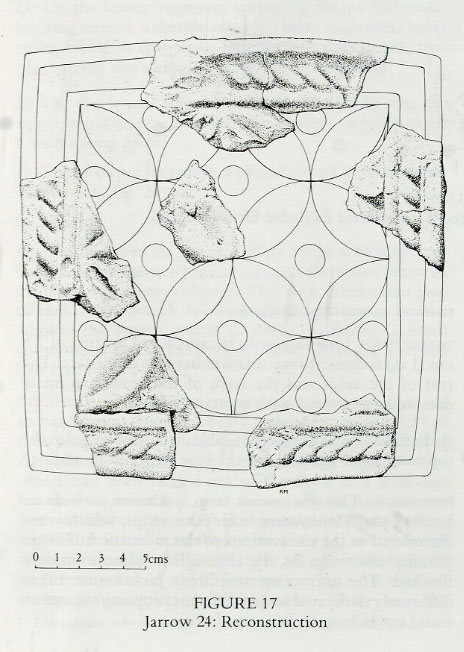
These pieces have obviously been dressed off a carved panel, no doubt in the destruction and rebuilding over the Saxon building. They seem to have formed part of the internal decoration of building A. It is impossible to be certain of the form the panel took. It could have been triangular as the curving sides could suggest, or it could have been rectangular (19 x 20.2 cm; 8 x 7.5 in), as shown in the reconstruction (Fig. 17). If the latter, the slight curve may have accommodated itself to a structural or decorative feature of the building. The decorative scheme of interlinked petals is commonplace in the late antique world (see the Vienna Dioscurides: Weitzmann 1977, pl. xvi). It also occurs in Visigothic Spain (Palol and Hirmer 1967, pl. 17), on Hexham 34 and on a carved pillar from Ripon which could be Roman or early Saxon. It would not be out of place as a decorative plaque on a building as consciously Roman in construction as building A at Jarrow.
