Select a site alphabetically from the choices shown in the box below. Alternatively, browse sculptural examples using the Forward/Back buttons.
Chapters for this volume, along with copies of original in-text images, are available here.


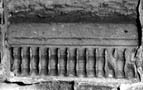
Object type: Three pieces of baluster frieze
Measurements:
Fragment a: H. 31.8 cm (12.5 in); W. 54.5 cm (21.5 in); D. Built in
Fragment b: H. 31.8 cm (12.5 in); W. 41 cm (16.1 in); D. Built in
Fragment c: H. 27.3 cm (10.75 in); W. 15.2 cm (6 in); D. Built in
Stone type: Medium-grained yellow sandstone
Plate numbers in printed volume: Pls. 101.540; 102.547-8
Corpus volume reference: Vol 1 p. 118-119
(There may be more views or larger images available for this item. Click on the thumbnail image to view.)
A (long): a and b represent a section of a possible frieze, c a section which is the right side in which the ornament shades off into a corner. These pieces consist of a slab in which the upper section has been cut back and dressed as though to receive plaster. There is then a wide flat border with an incised line below forming the upper line of a shallow roll moulding which frames a row of balusters; remains of thirty-six of these survive. The balusters have slightly splayed caps and bases marked by a roll moulding and a single incision around the centre of their bellying form. The `plinth' on which they stand seems to have been dressed smoothly underneath, as though this face was meant to be seen. There are signs of the use of a 2 mm punch above the baluster frieze on fragment b.
The function of these pieces is puzzling. They seem to have been built into a structure with an opening below, but their total width is greater than that of any single Saxon door of the pre-Viking period. Therefore they could either have formed the lintel of more than one door or have formed the capping of something like a baldachino or the upper part of a screen. It seems possible that they formed some interior fitment to the church and were complemented by the other architectural features with balusters such as imposts and cross-slabs. That they formed the surrounding features of an altar or even a baldachino is a possible interpretation. Into such a scheme other monumental free-standing balusters could have been incorporated, even if they were of a different shape. The shape of `balustrade' balusters is similar to that found in Roman work and also on the imposts and friezes at Hexham (nos. 23-8).
