Select a site alphabetically from the choices shown in the box below. Alternatively, browse sculptural examples using the Forward/Back buttons.
Chapters for this volume, along with copies of original in-text images, are available here.


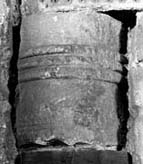
Object type: Twenty-five baluster shafts
Measurements:
b and e-t: H. 73 cm (28.7 in); Diameter 31 cm (12 in)
a: H. 29.5 cm (11.6 in)
c: H. 43.5 cm (17.1 in)
D: H. 30.5 cm (12 in)
u: H. 21 cm (8.25 in)
v:H. 28 cm (11 in)
w: H. 23 cm (9 in)
x :H. 19.5 cm (7.7 in)
y: H. 14 cm (5.5 in
a, c, d and u-y: Diameter incomplete
Stone type: Medium-grained yellow sandstone
Plate numbers in printed volume: Figs. 9-10 in the Grammar of Anglo-Saxon Ornament, Pls. 103.551-558, 104.559-565, 105.566-570, 106.571-575
Corpus volume reference: Vol 1 p. 120-121
(There may be more views or larger images available for this item. Click on the thumbnail image to view.)
The seventeen complete examples are of a standard height and, where this can be checked, each have a hole at one end (diameter 5 cm (2 in)), presumably for fitting on a lathe. The profiles conform to one of three types (see Figs. 9–10):
Type i (Fig. 9): d, f, h, l, n, r, u, x, and probably also a and v
Type ii (Fig. 9): b, g, j, o, w, and probably m and y
Type iii (Fig. 10): c, e, i, k, p, q, s, t
The uniform height of these pieces makes it likely that they were all part of one feature. They differ markedly from the Monkwearmouth pieces in that only types ii and iii have the close incised lines and none have the sharply angled bands (Introduction, Figs. 9-10). The coarser, more rounded outlines could indicate a deterioration of technique, or could be due to the difference in stone type (soft limestone at Monkwearmouth and sandstone at Jarrow). The Jarrow balusters, with single mouldings and deep uncarved areas at the top and bottom, could point the way to the later type of mid-wall shafts which are not lathe-turned (see Greatham 3). The relationship of the uniform balusters to the `lintels' with balustrade ornament and the other friezes is uncertain, but it appears likely that those at Jarrow (nos. 25-9) are attempts to copy the modes of enclosing the altar and perhaps a schola cantorum, such as existed in contemporary Roman churches.
