Select a site alphabetically from the choices shown in the box below. Alternatively, browse sculptural examples using the Forward/Back buttons.
Chapters for this volume, along with copies of original in-text images, are available here.


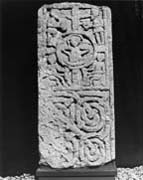
Object type: Incomplete cross-shaft [1]
Measurements: H. 79 cm (31 in); W. 35.5 > 33.5 cm (14 > 13.25 in); D. 12.5 cm (5 in)
Stone type: Coarse-grained, massive yellow sandstone
Plate numbers in printed volume: Pl. 190.1050-1054
Corpus volume reference: Vol 1 p. 195-196
(There may be more views or larger images available for this item. Click on the thumbnail image to view.)
A (broad): The face is outlined by a single flat-band moulding, and divided into two panels. (i) Complete, and framed by an inner roll moulding. It is divided into quadrants by wide rectangular bands attached to a central circular feature. In the circle is a frontal figure, squatting and with arms akimbo. The head is surrounded by a halo, the face is wedge-shaped and has lightly marked eyes and mouth. It appears to be nude. In the upper quadrants stand two side-facing figures. Each holds a book or mallet in his right hand. They are bearded, bare-legged and wear short tunics. Issuing from or attached to their mouths are horizontal trumpet-like features. In the lower quadrants are two three-quarter facing figures seated on chairs. Each holds a horn or scroll in his right hand and has the left arm across his knee. Their faces are wedge-shaped with lightly incised eyes and mouths. They seem to be unclothed and it is impossible to determine their sex. (ii) Interlace: two pairs of units of spiralled pattern A, a twelve-cord mirror image pattern.
B (narrow): Five panels, alternately plain and decorated with interlace. (i) Little survives of this plain panel. (ii) Two pairs of turned pattern C loops, with bar terminals. (iii) and (v) Plain. (iv) Two pairs of pattern A loops, with cross-joined terminals.
C (broad): Destroyed.
D (narrow): Divided into four panels with punch-outlined flat mouldings. No vertical mouldings survive. (i) and (iii) Plain. (ii) A single register of pattern C with outside strands forming a ring-knot. (iv) Interlace too worn to decipher with certainty, but with pattern C loops.
Despite the difference in scale this shaft is clearly linked to the Alnmouth cross in the form of its interlace patterns, and to Lindisfarne 2, 4-6 in interlace types, layout and style of cutting. The alternation of plain and interlace panels is found on 5 and 6, and the figure style is found in a cruder form on 8. The interlace patterns link with the earlier Bernician `designed panel school' and later work of the Anglian revival in Durham. Like 2 the strands are well modelled and punch-outlined.
The iconography of the main figural panel is puzzling and rendered more difficult to interpret because of its crude style of carving and its worn condition. The central squatting figure is strongly reminiscent of squatting figures from Celtic metalwork (e.g. Henry 1965, pl. 91). It seems best, however, to interpret it as a seated Christ with a halo and contained in a mandorla. Is this however a Christ in Majesty, a Judgement scene, or even a Deposition scene? The main difficulty is to know whether the cruciform division of the field represents a cross. If it does, then it suggests either a Deposition or a Judgement scene. If it were a Deposition, the figures with beards and secular dress above could be seen as wielding hammers; figures bearing horns can be seen on a cross from Barochan – a cross which also shares one interlace pattern with this cross (Allen 1903, fig. 475). However, a seated Christ in a mandorla is not a usual feature of Crucifixion or Deposition iconography and it seems more reasonable to interpret this as a Judgement scene. The figures in the upper quadrants could then be seen as holding books and blowing trumpets (Peers 1923-4, 268). The seated figures below could be holding scrolls with the names of the dead or could be holding trumpets also. Christ in a mandorla could appear against the background of the cross, since the simultaneous appearance of Christ and the great cosmic cross on the Day of Judgement is known from Anglo-Saxon poetry. The rather lumpy figure style and the wedge-shaped heads certainly compare with crosses of south-west Scotland, such as Barochan. The period when the island was cut off from the south and became more closely linked with Scotland could provide a reasonable date for this piece.
