Select a site alphabetically from the choices shown in the box below. Alternatively, browse sculptural examples using the Forward/Back buttons.
Chapters for this volume, along with copies of original in-text images, are available here.


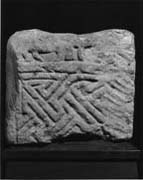
Object type: Incomplete cross-shaft [1]
Measurements: H. 37 cm (14.5 in); W. 40 cm (15.75 in); D. 18 cm (7 in)
Stone type: Coarse-grained, massive yellow sandstone
Plate numbers in printed volume: Pl. 191.1055-1058
Corpus volume reference: Vol 1 p. 196-197
(There may be more views or larger images available for this item. Click on the thumbnail image to view.)
A (broad): Part of a single flat-band moulding survives on the left and a horizontal flat-band divides the face into two panels. (i) The upper panel scarcely survives but seems to show a standing quadruped on the left divided from another figure by a rectangular upright. (ii) A panel of fret-work (Allen 1903, no. 987).
B (narrow): Part of an upright moulding survives, punched in outline, on two panels, also punch-outlined. (i) A ring-knot of bungled design, and part of a second incomplete motif. (ii) Plain.
C (broad): One incomplete panel of fret-work (Allen 1903, no. 947).
D (narrow): Plain, and although worn was possibly never carved.
This is clearly part of the same group as 6, but not as competently carved; its technique is intermediate between a modelled and a grooved style. The frets are less finely drawn and less skilfully carved than Norham 5. In the ring-knot the curved loops do not turn correctly and strands are lost as they leave the knot.
