Select a site alphabetically from the choices shown in the box below. Alternatively, browse sculptural examples using the Forward/Back buttons.
Chapters for this volume, along with copies of original in-text images, are available here.


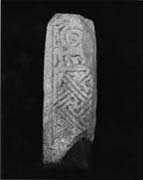
Object type: Incomplete cross-shaft [1]
Measurements: H. 63.5 cm (25 in); W. (incomplete) 21.5 cm (8.5 in); D. 21.5 > 19 cm (8.5 > 7.5 in)
Stone type: Coarse-grained, massive yellow sandstone
Plate numbers in printed volume: Pl. 193.1071-1074
Corpus volume reference: Vol 1 p. 197
(There may be more views or larger images available for this item. Click on the thumbnail image to view.)
Part of three faces survive.
A (broad): One vertical flat-band moulding survives on the left and the face is divided by a horizontal roll moulding. (i) The remains of a quadruped with a long tail and neck coiled back. (ii) A key pattern (Allen 1903, no. 987 repeated).
B (narrow): Missing.
C (broad): Part of an outer flat-band and inner roll moulding survive on the right, and a horizontal grooved divider separates the panels. (i) Two joined units of fret-work (Allen 1903, no. 1004). (ii) Part of another panel of unidentifiable fret.
D (narrow): Four panels survive, two incomplete, outlined by a grooved moulding. (i) Interlace which can be reconstructed into two elements of turned closed circuit pattern D with bar terminals. (ii) Plain. (iii) A single fret (Allen 1903, no. 987). (iv) Incomplete single unit of spiralled half pattern A with bar terminal (Adcock 1974, pl.130c).
This shaft which is closely related to 5 seems to represent a change from the designed panels of interlace with ribbon animals to a style which used freestanding animals and frets, and in which the art of designing complex interlace panels had been lost. There could have been influence from Norham work and the animal is like the Jedburgh base (Allen 1903, 457).
