Select a site alphabetically from the choices shown in the box below. Alternatively, browse sculptural examples using the Forward/Back buttons.
Chapters for this volume, along with copies of original in-text images, are available here.


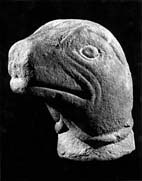
Object type: Animal-head terminal
Measurements: H. 30 cm (11.8 in); W. 31 cm (12.2 in); D. 18 cm (7.1 in)
Stone type: Medium-grained, massive yellow sandstone
Plate numbers in printed volume: Pl. 124.673-676
Corpus volume reference: Vol 1 p. 130-131
(There may be more views or larger images available for this item. Click on the thumbnail image to view.)
The animal head is three-dimensional. It is a type something between a mammal and a reptile, with a short squared-off snout, long slit mouth outlined by grooves to simulate loose folds of skin, which also curve round its lentoid eye. It has a deeply carved collar round its neck which rises to a point under its lower jaws. The curve of the top of the head is emphasized by a shallow roll moulding.
The function of this terminal is not entirely clear. However, it does seem meant to be seen in an upright position, in which the head markings would be visible, rather than horizontally, projecting corbel-like from a wall. Its closest formal parallel is an animal head from Lastingham, which also has patterning on the top of the head (pl. 267, 1438-9). Both pieces could be terminals of the arms of a chair, but the more massive proportions of the Monkwearmouth animal seem to imply that it was the tip of a column-like feature rather than a rectangular arm or leg. Stylistically such chairs may be compared with those seen in manuscripts in which Classical lion-like animals are given a native appearance (see Lichfield Gospels, St Luke, p. 218: Kendrick 1938, pl. 53; Durham B.II.30, fol. 81v: ibid., pl. 54).
