Select a site alphabetically from the choices shown in the box below. Alternatively, browse sculptural examples using the Forward/Back buttons.
Chapters for this volume, along with copies of original in-text images, are available here.


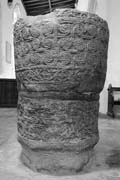
Object type: Font bowl and stem
Measurements:
H. 104.6 cm (41 in); font bowl 51.4 cm (20 in); cement fillet 5 cm (2 in); font stem 48.2 cm (19 in)
Diameter at top of bowl 75 cm (29.5 in); diameter of stem just above the octagonal basal chamfers 65.6 > 65.2 cm (25.8 > 25.6 in)
Stone type:
3a. Font bowl: moderate reddish brown (10R 4/6) clast to matrix supported, sparry-cemented sparsely oolitic very shelly limestone. The ooliths range in size from 0.5 to 1 mm and the shell debris up to 10 mm. The shell debris seems to be mainly of bivalve origin with some cidarid spines. Some crude bedding can be seen parallel to the rim of the font. Crickley Member, Birdlip Limestone Formation, Inferior Oolite Group, Middle Jurassic. The upper part of this member constitutes what has been referred to as the Pea Grit but the stone making up this font seems to come from the lower part of the member.
3b. Font stem: moderate reddish brown (10R 4/6) clast supported, spar cemented sparsely oolitic very shelly limestone. Subordinate ooliths 0.2 to 0.8 mm in size with shell debris ?mainly oyster fragments up to 10 mm. Cidarid spines. Crickley Member, Birdlip Limestone Formation, Inferior Oolite Group, Middle Jurassic. The upper part of this member constitutes what has been referred to as the Pea Grit but the stone making up this font seems to come from the lower part of the member.
Plate numbers in printed volume: Ills. 132-44, 740; Figs. 24J-K, 27L, 40
Corpus volume reference: Vol 10 p. 163-8
(There may be more views or larger images available for this item. Click on the thumbnail image to view.)
The earliest reference to the Deerhurst font would seem to date from the middle of the seventeenth century. On 17 February 1663 William Haines was accused at Gloucester Consistory Court 'for that in the yeare 1653 he caused the Font to be pulled down' ((—) 2004, citing Gloucestershire Archives, GDR 210). Deerhurst subsequently acquired a new font. In 1845 a drawing of the [bowl of the] old font by W H Gomonde was exhibited at a meeting of the British Archaeological Association, and a letter was read expressing concern for its future. Gomonde commented that the font 'was kept in a farm-yard for many years' and added that 'I am afraid [that] it will be no more seen, as I hear it has been sold for the sum of ?6, and carried away I know not where' ((—) 1846a, 65). These fears were unfounded, as the font had been transferred to Longdon Church (Worcestershire) under the auspices of members of the Chapter of Westminster Abbey; Westminster Abbey held manors in both Deerhurst and Longdon. Butterworth initially ascribed the initiative to Samuel Wilberforce during his brief tenure of the deanery of Westminster between the spring and autumn of 1845, but later gave the date as 1843 and assigned the credit to Dean Turton (1842–5) (Butterworth 1890, 115–16). However, an entry in the Westminster Abbey chapter minutes dated 30 July 1844 ordered 'that five pounds, 5 shillings be placed in the hands of Mr Frere for the obtaining of a Font for Longdon Church' (Westminster Abbey Chapter Act Book 18 (1843–9), p. 89). Canon Temple Frere was a member of the Chapter of Westminster, and had visited the nearby parish of The Leigh shortly before the Chapter meeting. It thus seems likely that Frere was the moving spirit in the transfer of the font from Deerhurst to Longdon. Shortly before 11 April 1868, Miss Frances Strickland of Apperley Court, Deerhurst discovered what is now the stem of the Deerhurst font at or near the Coal House, Deerhurst (SO 855284); the details are given in a letter from the Revd. George Butterworth to Miss Strickland congratulating her on the discovery (Gloucestershire Archives, D1245 F52). The stem had apparently been 'used as a kind of rustic ornament to the garden' (Hudd 1886–7, 93). The stem was taken to Deerhurst church, and the incumbent of Longdon church, which was then under restoration, was prevailed upon to exchange the font acquired in the 1840s for a new font given by Miss Strickland. The exchanges were completed by the gift of the Restoration font which Deerhurst had acquired to Castlemorton Church, a chapelry of Longdon.
3a: Cylindrical font bowl with large panels of relief carving in which the background is cut back c. 0.5–1 cm (0.2–0.4 in). The font tapers from the rim to the base. The large panels are bounded at the top and bottom by narrow borders containing spiral plant-scrolls also carved in relief. The boundaries between the main panels and the upper and lower borders are marked with fairly flat mouldings, while the bottom of the bowl carries a wide roll-moulding. There are eight main panels, divided from each other by flat vertical mouldings and each containing grids of interlocking, opposed 'C-curve spirals'. As with the decoration on the shaft from Elmstone Hardwicke (Ills. 242–7), the spirals and straight linking lines are carved to an even width, with no swelling as found in trumpet scrolls and pelta, and the term 'bracketed-spiral' is used below as a clearer description of the motif. The plant-scrolls around the top and bottom of the bowl are carved with sinuous, sweeping stems and loose simple spirals, at the centre of each of which there is a 'fruit plus multiple leaf' cruciform motif or, less frequently, a berry bunch. Side shoots ending in lobed leaves with curling tips grow from the outer curves of the volutes to fill the interstices between the spirals, while the junctions between the volutes and the main stems are marked by simple oval node buds or buds with flanking leaves. In one case the junction is marked with a small berry bunch with broad, flanking leaves.
3b: Cylindrical font stem, slightly flattened on the south side, with alternating panels filled with ribbon-bodied creatures enmeshed in interlace and panels of interlocking, opposed 'C-curve spiral' carving of the 'bracketed-spiral' type found on the bowl above and at Elmstone Hardwicke. There are seven panels around the stem, divided from one another by flat vertical mouldings. Three contain bracket-spirals and three contain ribbon-bodied creatures. The heavily eroded surface of the stem makes it especially difficult to interpret the seventh panel, but under raking light it is just possible to trace fragmentary areas of the original surface and this seems to indicate that this panel was not cut back but left flush with the outer face of the mouldings that divide the other six panels. Details of the ribbon-beast panels are also difficult to disentangle, but drawings made by Steven Plunkett based upon rubbings show the main outlines of the designs (Plunkett 1984, ii, pl. 69; see Bailey 2005, pl. 8). One panel contains two opposed snake-like creatures whose bodies form the median-incised mesh of interlace that covers the panel. The animals are open-jawed and they eat their own tails. Between their mouths, just below their overlapping tails, there is a round pellet. The second ribbon-beast panel is very similar, except that there is an area of hatched infill within the neck of one snake and part of one of the tails carries double incised lines. The third panel contains a single creature caught in a tangle of interlace. The creature has a sinuous body and at least two legs. The head is turned backwards so that the creature can bite one of the strands of interlace. Carved detailing on what is now the upper part of the stem has been lost due to erosion. Below the carved panels there is a wide roll-moulding and below this the circular stem has been cut into eight faces that curve inwards to form concave, tapering foot recesses around the base of the font.
Both face F (bottom) of the font bowl and faces E and F (top and bottom) of the stem were described by Butterworth as plain and unbroken (Hudd 1886–7, 103).
The font stands on an octagonal stone plinth that may predate the reinstatement of the font in the church, when bowl and stem were set up in their present position at the end of the nineteenth century. To judge by the fact that all of the heads of the ribbon-animals point downwards, it seems probable that when installed, the stem stone was set upside down.
Appendix K item (Fonts and stoups in the Western Midlands).
The carving on the font bowl and stem at Deerhurst St Mary has long been compared with that on the Elmstone Hardwicke stone (p. 198, Ills. 242–7), less than three miles away to the east (see for example Hudd 1886–7, 100–2). The 'bracketed-spiral' motif that is used in densely packed panels on all three is rare in Anglo-Saxon sculpture and found nowhere else in Gloucestershire or in western Mercia. Related designs are found in eastern Mercia, for example the panel of trumpet spirals arranged in pelta pattern (together with single spirals described as leaf-whorls and set within a running spiral scroll) at Breedon-on-the-Hill in Leicestershire (Jewell 1986, 96–7, 103, pls. XLII, L). A second 'complex field of trumpet-spirals ... based around a triskele of three rounded forms' survives with other fragments of a panel or group of panels at South Kyme in Lincolnshire (Everson and Stocker 1999, 249, ills. 339, 343). The Breedon friezes are dated to the early ninth century, and the South Kyme panel to the late eighth or early ninth century. One of the carved whale-bone panels on the side of the Anglo-Saxon Gandersheim casket shows a triple triskele pattern of trumpet scrolls and is dated to the late eighth century (Webster and Backhouse 1991, 177–9, ill. 138). Interlocking C-spirals occur on many of the eighth- to ninth-century Pictish carved stones from Scotland, for example the Dupplin cross-head (Perthshire), the St Vigeans cross-slab 2 (Angus), the panel TR20 from a monumental cross-slab at Tarbat, the damaged panel on a cross-slab from Hilton of Cadboll, and a large panel on one face of the Shandwick cross-slab (all Ross and Cromarty) (Foster and Cross 2005, 23, 40–1, 207, 218, 247, figs. 2.9, 3.1, 3.2, 13.3, 14.3, 16.2). However, on most Scottish examples the bracket linking the spirals is swelled, trumpet-ornamented or drawn-down between the spirals. Hiberno-Saxon manuscripts of the eighth century abound with spirals, trumpet scrolls and pelta. Examples occur on the miniature of King David and his musicians in the Vespasian Psalter fol. 30v, and St John from the Codex Aureus, fol. 150v — both dated to the mid eighth century (Alexander 1978, 55–7, cats. 29, 30, ills. 146, 147), but, as with most of the painted manuscript motifs, the designs are more curved and flowing, less regimented than the Gloucestershire carved examples. In this respect the decoration on both the Deerhurst font and the Elmstone Hardwicke shaft is more like the carving on a small fragment from Drainie in Scotland (Drainie 2, Moray; online catalogue for Drainie on ScotlandsPlaces.gov.uk), and even more closely related to panels on some of the ninth- century Irish High Crosses, for example the South Cross, Castledermot (Co. Kildare — see Ills. 784–5) and the Kinnitty Cross (Co. Offaly) (Richardson and Scarry 1990, pls. 42, 129; Crawford 1980, pls. XV.1,3, XVI.1,3). Irish parallels were first suggested by J. O. Westwood in a letter written to the British Archaeological Association in response to Gomonde's letter (see above: Evidence for Discovery) ((—) 1846b, 249–51), also quoted at length by Hudd (Hudd 1886–7, 94–5). These design ideas could easily have been passed on by Irish monks, and Sims-Williams suggests that there might even have been Irish settlements in the area (Sims-Williams 1990, 32–3, 106–8, 183–5, 247, 276–9). However, the closest parallel for both the straight-backed, 'bracketed-spiral' form and the densely packed overall design is the badly worn eighth-century panel from Bradford-on-Avon, Wiltshire (Cramp 2006, 205, ills. 407–9).
The ribbon-bodied creatures in the panels on the font stem are members of a widespread family of creatures that are found on Anglo-Saxon metalwork and in manuscript illumination of the eighth century and later. The creatures also occur on Anglo-Saxon stone carvings across much of England, with a significant preponderance of examples occurring in western Mercia and Wessex. The phenomenon has been discussed by Plunkett, and more recently by Tweddle and by Cramp, where dates for the development of the creatures from the late eighth to early ninth to tenth centuries have been suggested (Plunkett 1984, i, 180–202; Tweddle in Tweddle et al. 1995, 34–40; Cramp 2006, 42–8). Paired, snake-like creatures enmeshed in interlace that is often derived from their bodies can be found on late eighth- or early ninth-century carvings at West Camel (Somerset), Dolton (Devon), and Steventon (Hampshire) (Cramp 2006, 83–5, 178–9, ills. 20–5, 346–8; Tweddle et al. 1995, 267–8, ills. 471–2). 'S'-shaped creatures occur on ninth-century cross-shafts at Ramsbury, Wiltshire (Cramp 2006, 228–9, ills. 485–6, 495–7) and Tenbury Wells, Worcestershire (this volume, Tenbury Wells 1, p. 365, Ills. 660–7). A pair of 'S'-shaped creatures on a tenth-/eleventh-century shaft from Aycliffe (Co. Durham) has long thin legs (Cramp 1984, 41–3, pl. 8.28). As well as the Tenbury Wells example mentioned above, related creatures occur in Gloucestershire at Abson (Abson 1, Ill. 1), on the Wotton Pitch cross-shaft (Gloucester London Road 1, Ills. 359, 361), and on two of the cross-shafts from St Oswald's in Gloucester (St Oswald 3 and 4, Ills. 278–86, 287–91). All of these west Mercian examples are dated to the ninth century.
The surface of the seventh panel on the stem seems to have been left un-carved, and this may indicate that this panel carried a painted inscription similar to that proposed for Deerhurst St Mary 6 (p. 172, Ill. 150).
The final elements of the decoration on the font are the plant-scrolls on the upper and lower borders around the bowl. In manuscript art a comparatively narrow plant-scroll can be seen in the late eighth-/ninth-century Canterbury Gospels (BL, Royal MS 1. E. VI, fol. 4r) on the arch above the canon table. Tri-lobed and rounded buds spring from the nodes on the scroll stem, while leaves and curling tipped tendrils sprout from the outer edges of the volutes to fill the interstices (Alexander 1978, 58–9, cat. 32, ills. 162–4). In Mercian stone carving the most extensive example of a plant-scroll confined within a narrow register is the early ninth-century single-stem scroll on one of the narrow friezes from Breedon-on-the-Hill, Leicestershire (Jewell 1986, 96–100, pls. XLII–III). Here the spiral volutes end in a variety of trefoil, oval and heart-shaped leaves, berry bunches and leaf-whorls, and the interstices are occupied by tendrils or leaves. There are no lobed leaves at Breedon, but they are found on the ninth-century Cropthorne cross-head and the Lechmere Stone, both Worcestershire (Cropthorne 1, Ills. 621, 625; Hanley Castle 1, Ills. 638–41). The triangular leaf form and simple volutes occur on the late eighth-century cross-shaft from St Oswald's, Gloucester (St Oswald 1, Ills. 265–9). The font's plant-scrolls have also been compared with the recently discovered painted plant-scroll that covers the chancel arch in Deerhurst church (Gem et al. 2008, 147–50; see Fig. 36, p. 113).
In his discussion of the Anglo-Saxon sculptures from Deerhurst, from which several of the comparative examples above have been taken, Bailey suggests that the combination on the font bowl and stem of the 'bracket-spiral' panels with panels containing interlace knotwork that terminates in confronted animal heads, and borders with foliate and fruiting spiral scrolls, would support a date for the carving in 'the period around the beginning of the ninth century' (Bailey 2005, 17–21). The present author supports the view that the font should be seen as part of a coherent body of work at the church dating from the first half of the ninth century.
The Deerhurst font stones and the Elmstone Hardwicke shaft
Geological analysis of the distinctive type of stone from which the bowl and stem of the Deerhurst font and the Elmstone Hardwicke shaft have been carved indicates that all three stones come from a specific bed within the Inferior Oolite (the Crickley Member in the Birdlip Limestone Formation). This stone is not used for any other Anglo-Saxon carving in Gloucestershire and the identification lends further support to the contemporaneity of the pieces. This has led to suggestions that all three stones might originally have been part of a single monument (a lost High Cross), but, with some reluctance after undertaking detailed measurements and cross-sections of all three stones, the author has had to accept that the stones do not fit together (for the detailed discussion of the reasons why the Elmstone Hardwicke shaft does not fit either of the Deerhurst stones, see Elmstone Hardwicke 1 in this volume, p. 198).
Looking again at the two Deerhurst stones, the structural analysis referred to above has also challenged the long-held belief that the bowl of the font fits comfortably onto the stem. The stem seems to be essentially straight sided and therefore, even if it is turned upside down to correctly orientate the carvings, the top diameter would be roughly the same as the present top. However, the present top of the stem is a little wider along its present north-west/south-east axis than along the north-east/south-west axis (64.4 cm to 63.8 cm), and the close fit between the stem and the bottom of the bowl is largely due to the loss of a section of the lower part of the bowl and the basal roll-moulding in the south-western quadrant of the font. Some of this area of lost stone has been made up with a rather basic patch of cement, similar to the jointing layer between the bowl and the stem, and therefore, presumably, of late nineteenth-century date. If the original profile of the lost area of stone is reinstated (by using the undamaged profiles from elsewhere on the bowl), then the diameter of the bottom of the bowl is seen to be wider and more regular than the top of the stem, and the bowl sits slightly off-centre. This does not necessarily preclude the assumption that the bowl and stem were designed to go together; if centred, the bowl would not be too much wider than the stem. However, it does raise or in one case raise again, two intriguing alternative possibilities: (a) that the two parts of the font were originally part of a single, but different monument, or (b) that the two elements of the font were originally completely separate items.
(a) The fact that the Elmstone Hardwicke stone has been discounted as a component of a single monument, including the two Deerhurst stones, does not of itself mean that the two Deerhurst stones must also be discounted as sections of, for example, a round-shafted High Cross. However, even allowing for the fact that the taper of the bowl has been exaggerated and shouldered on one side by the loss of a section of the lower part of the bowl and the basal moulding, the difference in the profiles of the two stones is quite marked. They are not that different in diameter and the change from tapering to straight-sided would therefore have occurred quite abruptly (see Fig. 40). The present author, therefore, agrees with Richard Bailey in rejecting this suggestion (Bailey 2005, 16).
(b) Could the two Deerhurst stones belong to separate items? We have already acknowledged that there were two separate monuments bearing the same decorative motifs and carved from the same type of stone, one the cross-shaft at Elmstone Hardwicke and the other at Deerhurst, so a group of three closely-related monuments is not impossible. The fact that the bowl of the font is divided into eight panels and the stem into seven could be seen to further support the suggestion that the stem of the font was perhaps originally part of a round-shafted cross, perhaps with a painted inscription (see above), and the bowl of the font originally stood on its own, probably on a low platform similar to the eleventh-century circular plinth excavated in the middle of the nave at St Mary de Lode church in Gloucester (Bryant and Heighway 2003, 117–22, figs. 15–17). On the early ninth-century coped slab from Wirksworth in Derbyshire there is a scene in which just such a bowl stands on the floor, with a disciple standing in it while Christ washes his feet. Bailey, in a paper that included an analysis of the iconography of the Wirksworth slab, wrote about the linking of the Feet Washing with Baptism and with the Eucharist in early Christian thought, and quoted from a ninth-century Carolingian catechism: 'Why are those re-born at the font of baptism led to the table of the Lord? For the Lord after laving the feet of the apostles handed to them the mysteries of his body and his blood' (Bailey 1990, 7–8, 12–14; but see also Hawkes 1995, 247–9, 262–4, fig. 4).
The most recent discussions of Anglo-Saxon fonts appear in Cramp 2006 and Blair 2010, and some of these authors' conclusions are summarised in this volume under 'Further thoughts on fonts' (Chapter V, pp. 62–4), together with newly compiled comparative measurements of eighteen fonts from western England, and support for the present author's suggestion that Anglo-Saxon 'font' bowls might have been designed to be set on the ground or on a plinth.
Suffice it here to say that the lack of an original drainage hole (the present hole is probably nineteenth century) would be more understandable if the Deerhurst font was a stone version of a wooden or metal prototype, designed to be set low down and to be emptied by hand.
Whether the Deerhurst font stood originally on the ground or on the stem that is now an integral part, the present author agrees with Bailey that it seems to have been specifically designed for baptism. It is also by some margin the earliest surviving example in England.

Fig 40
SW-NW and SE-NW sections of the Deerhurst font (Deerhurst 3)
