Select a site alphabetically from the choices shown in the box below. Alternatively, browse sculptural examples using the Forward/Back buttons.
Chapters for this volume, along with copies of original in-text images, are available here.


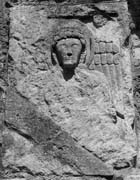
Object type: Panel with angel carving
Measurements: H. 80.8 cm (31.8 in); W. 59.2 (at top) > 56.4 cm (23.3 > 22.2 in); D. unknown
Stone type: Yellowish grey (5Y 8/1) grain supported shelly, spar cemented oolite with many hollow ooliths. Ooliths range in size from 0.2 to 0.8 mm and shell debris is up to 6 mm in size. The debris consists mainly of bivalve / brachiopod fragments. Cleeve Cloud Member, Birdlip Limestone Formation, Inferior Oolite Group, Middle Jurassic.
Plate numbers in printed volume: Ills. 145-6; Fig. 33D
Corpus volume reference: Vol 10 p. 168-70
(There may be more views or larger images available for this item. Click on the thumbnail image to view.)
In situ. In describing the apse, Buckler (1886–7, 37) noted the existence of 'a ponderous cube of stone, on the surface of which is a rudely carved head of the Saxon type'. The angel was fully revealed by the Gloucestershire antiquary, W. St Clair Baddeley on 25 November 1914. The details are given in a characteristically cantankerous letter (Baddeley 1928). Baddeley had observed the head of the figure protruding through plaster; after borrowing a ladder, he removed 'several layers' of plaster 'with my pen-knife and a bradawl', exposing the angel to full view. Rough sketches dated 20 November 1914 and 15 January 1915 by a friend of St Clair Baddeley, J. D. Grimké Drayton, show the situation before and after St Clair Baddeley's work (Gloucestershire Archives, Gloucestershire Collection, SRprints/93.7GS). There is no indication as to whether the layers of plaster belonged to the medieval church or were associated with the domestic structure which abutted the surviving wall of the apse until the early nineteenth century (Rahtz 1976, 17).
High-relief carving of an angel or archangel on a slightly tapering, rectangular panel. The figure's face is well-modelled and youthful, with a long straight jaw line and rounded chin in the middle of which is a dimple. Looked at straight-on the face is much less gaunt than has been suggested in many earlier descriptions. The mouth is small and the centre of the upper lip is drawn down as though slightly pursed. The nose is quite narrow with rounded, rather wedge-shaped nostrils. The eyes are big and wide open, with slightly convex pupils and well-delineated eyebrows and upper eyelids. The hair is combed forward in two rows of curls and gathered at the sides of the head into triple ties, before falling across the shoulders in triple strands either side of the neck, almost like a high collar. The ears are not visible. Behind the head rises a large halo. Of the rest of the figure, only the line of the shoulders, the upper outer side of the left arm and, possibly, the last vestiges of folded fabric at the figure's left elbow have survived. All other details of the body and arms have been cut away. From behind the shoulders, and overlapping the lower outer edges of the halo, rise the angel's wings. On the figure's right only the bend of the wing and a few feathers survive, but on the figure's left much can still be seen in deeply-carved detail, with even the up-raised tip of the wing visible, albeit without surface detail, against the lower edge of the panel's upper border. Indeed, a cut across the border, in line with the outer edge of the wing, might indicate that the wingtip lay across the border rather than simply touching it. The inner bend of the wing curves up as a plain, flat-section border, mimicking the curve of the halo behind. At the level of the top of the figure's brow, this border turns sharply away from the head before curving upwards to the tip of the wing. There are two complete rows of rather rectangular wing-covert feathers below the remains of a third row, while the long, straight, primary flight feathers are gathered into a curving wing tip just behind the elbow. The panel was originally finished, at least at the top and down the side to the figure's left, with a wide, plain border, the face of which survives in the upper corner.
The Angel or Archangel has been the subject of much art-historical debate. Kendrick described it as a 'noble work of art, one that is distinguished alike for its incisive clarity and its tranquil imposing solemnity'. He felt that the panel belonged to the closing days of King Alfred's reign (Kendrick 1938, 217). Rosemary Cramp drew particular attention to the figure's hair style, 'arranged in two rows of scallops in the manner of some Carolingian ivories when copying classical curls, or more remotely like the angels in the Book of Kells' (Cramp 1975, 195). This hair style is also clearly shown on the seventh-century frescoed head of a saint, probably St Sebastian, in the Sotterranei di San Saba in Rome (Milella 2005, 94, ill. 116). Initially Cramp suggested a date in the early tenth century for the Deerhurst panel, and later widened the date range to later ninth to tenth century (in a letter to P. Rahtz quoted in Rahtz et al. 1997, 147, Table VIII, no. 14). María Muñoz de Miguel believed that the figure should be dated to the ninth century (Muñoz de Miguel 1997, 36–8). Clapham and Talbot Rice considered the angel panel to be in its original position and, partly based upon that assumption, assigned the carving to the tenth century (Clapham 1930, 137; Rice 1952a, 92–3, pl. 8b). More recently, detailed archaeological recording of the whole of the surviving southern bay of the apse has confirmed that the carved panel is an integral part of the structure of the polygonal apse, but the authors proposed a date in the late eighth to early ninth century or later for the phase of rebuilding (Period IV) to which the polygonal apse belongs (Rahtz et al. 1997, 43–4, 166–70, figs. 26, 27, 29, 30, 104; Bagshaw et al. 2006, 85–96, figs. 12–14). Drawing in part on this revised dating for the building, Richard Bailey has recently proposed a date in the early ninth century for the angel carving, with 'perhaps the closest parallels [being] supplied by the Evangelist portraits and Matthew symbol in the Book of Cerne', a Mercian prayerbook compiled in Worcester or Lichfield and placed by Michelle Brown in the second quarter of the ninth century (Bailey 2005, 11–13; Brown 1996, 178). The present author believes that, with few exceptions (for example, the double triangular-headed opening, Deerhurst St Mary 23), all of the sculpture at Deerhurst belongs to a single major phase of building and embellishment as proposed by Rahtz et al. (1997, 175). However, the present author suggests that this phase should be equated with their Period IV rather than Period V, and that it should be dated to the first half of the ninth century (see discussion for Deerhurst St Mary 13, p. 179).
Having discussed the date of the sculpture, Bailey then pursues the possible function of the angel carving (Bailey 2005, 13–14). He reminds us that in 1963 MacKay suggested that the angel 'would appear to be a representation [of the 'man' symbol] of St Matthew' (MacKay 1963, 87), with three more of the seven panels being occupied by the other Evangelists' symbols. This would leave three panels for other figures or perhaps for windows. However Bailey believes that 'a much more alluring solution is staring us in the face'. Acknowledging that the polygonal apse must have had seven panels, he reminds us that this is the canonical number of archangels who were called upon in personal prayer and who acted, in some instances, as apotropaic, protective guardians (Bailey cites for example Kitzinger 1956, 279, 297–8 or Brown 1969, 38ff. in relation to the wooden coffin-reliquary of Cuthbert). According to this coherent and attractive hypothesis the angel needs to be promoted to an archangel and should be seen as 'the last remaining sentinel of a seven-strong detachment of spiritual guardians set over the church and its community' (Bailey 2005, 14). Kepler offered a succinct summary, in relation to the seven angels and the seven churches of the Book of Revelation, which enhances this proposal: 'In an age which held to the apocalyptic views of angelology, an angel was a special protector of each person or nation (or in this case a church). In the seven churches of Revelation each angel is an immanent guardian sharing in the life of the church, not a transcendent heavenly creature' (Kepler 1963, 34). The only slight problem with this interpretation is that, after the Council of Rome in 745, the proliferation of named angels and archangels was declared heretical and many were dismissed as apocryphal. These included the archangel Raguel who appears in the Book of Enoch and on a stone slab reused in the eighth-century Hypogée des Dunes near Poitiers (Camus 1989, 64), as well as in late eighth-/early ninth-century Anglo-Saxon manuscripts (James 1910). The Book of Cerne, already acknowledged above to be probably contemporary with the archangel carving, contains a prayer invoking protection which is addressed to only six archangels: Gabriel, Michael, Raphael, Uriel, Rumiel and Phannihel (Kuypers 1902, 153). An alternative hypothesis could therefore be six archangels flanking a central figure. Hare (2009, 38 n. 8; Hare and Kneen forthcoming) has suggested that such a figure might be the Virgin Mary to whom the church is dedicated and who, with the Christ child, already stands at the west end of the church over the main entrance (Deerhurst St Mary 5).
(See Chapter IX, p. 110, for a discussion of the archaeological and structural context for the Deerhurst sculpture.)
