Select a site alphabetically from the choices shown in the box below. Alternatively, browse sculptural examples using the Forward/Back buttons.
Chapters for this volume, along with copies of original in-text images, are available here.


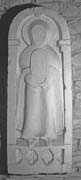
Object type: Carving of Virgin and Child
Measurements:
H. 103 cm (40.5 in); W. 42 (at base) < 42.5 cm (16.5 < 16.7 in); D. (to wall face) 7.5 cm (2.9 in)
Figure from crown of head to hem of robe: H. 79 cm (31 in)
Shield or clipeus: H. 21.5 cm (8.5 in); W. 12 cm (4.7 in)
Stone type: Yellowish grey (5Y 8/1) ?matrix supported muddy oolite with solid ooliths which range in size from 0.2 to 0.5 mm. Possibly recrystallised but more probably has been painted. Cleeve Cloud Member, Birdlip Limestone Formation, Inferior Oolite Group, Middle Jurassic.
Plate numbers in printed volume: Ills. 147-9; Fig. 33E
Corpus volume reference: Vol 10 p. 170-2
(There may be more views or larger images available for this item. Click on the thumbnail image to view.)
In situ. Noted in present position by Haigh (1846, 14) and Butterworth (1862, 94). The surrounding masonry shows no sign of any disturbance caused by insertion.
The haloed female figure is carved in high relief under a semi-circular arch, which rises from square jambs each 5 cm (2 in) wide with stepped capitals. A slightly raised patera disc 6.5 cm (2.6 in) in diameter marks the centre point of the arch, and two more discs (one 7 cm (2.8 in) and the other 6.5 cm (2.6 in) in diameter) mark the lower corners of the deeply-cut platform that forms the border of the panel below the figure's feet. There is a row of four deeply-cut, step-sided, cruciform recesses in the basal platform. The figure has rounded shoulders, and wears a floor-length, full-skirted garment and a hooded over-garment. She also wears rather pointed shoes. But the area of the face is flat and featureless. In her clasped hands the figure holds up an oval clipeus or shield in front of her breast. Trailing material from the over-garment is pushed back above the wrists and falls on either side of the figure. The hands are very large with some of the fingers overlapping and the thumbs, touching tip to tip, directly below the lower edge of the clipeus.
An incised setting-out line runs vertically down the centre of the figure's 'face', across the clipeus and onto the hands below the clipeus. The border of the clipeus is also defined by an incised line, and further incised setting-out lines can be seen on the basal platform and on the northern capital. There is a tiny hole at the centre of the upper patera which could have been the setting for a compass. There is a similar hole in the lower left patera, but in this case, if a circle was marked out, the subsequent carving did not follow the inscribed curves with any accuracy. The lower right patera is too damaged for any similar hole to be visible.
The carving has been burnished smooth to form a surface for paint, and it is generally assumed that the finer detailing of the face and the clipeus would also have been added in paint. Tiny traces of red paint do in fact survive over much of the surface and around the hem of the figure's garments, in the halo area, on the clipeus, in the sunken background, and on the patera discs. One tiny fragment of a deeper purple red survives in the background beside the halo, while ochre paint fragments have been recorded in the deeply recessed areas of the basal platform. Analysis of a paint sample taken from the hem has established that the red paint is iron oxide red and that it was applied directly to the smoothed stone surface, as it was on the contemporary polychrome animal heads and chancel arch painting at the church (Howe 2006a; Gem et al. 2008, 130; see Chapter X above).
The simple, 'blocked-out' nature of the Virgin panel is very similar to the southern beast head on the chancel arch (Deerhurst St Mary 19) and to the prokrossos and animal heads on the high-level doorway in the west face of the porch/tower (Deerhurst St Mary 10, 11 and 12). In the case of the chancel-arch animal head, and probably in the case of the other examples as well, more detail was added in paint. This was clearly also the case with the Virgin panel, and enough paint survives to provide the basis of a reconstruction of the polychrome scheme, excluding the Virgin's face and the clipeus (Gem et al. 2008, 139–42, fig. 47).
The iconography of the panel is unique in Anglo-Saxon England. In 1932 Casson included the carving in a group of Anglo-Saxon sculpture that he felt was inspired by Byzantine prototypes, as did Talbot Rice in 1952 (Casson 1933, 32–5, pl. III; Rice 1952a, 106–7, pl. 18a). Casson suggested that the Virgin fell 'into the category called by Byzantine iconographers the 'Panaghia Platytera' in which the Christ is shown on a medallion over the Virgin's breast'. Talbot Rice compared the Virgin panel to an 'iconographical type known as the Nicopea Virgin ... [in which] our Lady stands holding before her ... a medallion bearing the image of the Child Christ upon it'. This observation was further enhanced in 1997 by María Muñoz de Miguel, who proposed that the carving depicted the Virgin holding a clipeus (or shield) on which the figure of Christ was painted — the clipeus being an imperial Roman device, used to represent emperors or holders of high office, adopted into Christian art (Muñoz de Miguel 1997, 29–36)
Similarly, in 2005 Richard Bailey described the carving as the Virgin holding a clipeus on which Christ was displayed. He then further refined the parallels by making a distinction between circular shields and oval shields like the Deerhurst example. On the circular shields Christ normally appears as a portrait bust, while on the oval shields Christ is shown full length, usually as an adult 'thus emphasising the pre-existent nature of the now-incarnate Deity, who is everlasting as well as man born of Mary' (Bailey 2005, 8–10). Bailey and Muñoz de Miguel give several late sixth- and early seventh-century parallels for the oval type of shield from the eastern Mediterranean, and two early western parallels. Of the eastern examples, a miniature from a late sixth-century Syriac Bible, perhaps from eastern Turkey, offers a particularly close parallel for the Deerhurst carving (Paris, Biblioth?que Nationale, MS Syr. 341, fol. 118; reproduced in Muñoz de Miguel 1997, 32–3, fig. 2). One of the western examples is a wall painting in S. Maria Antiqua in the Forum in Rome and is dated between 757 and 767; the second is a mid ninth-century fresco from S. Maria in Insula at San Vincenzo al Volturno. The Deerhurst carving is clearly an unusual and significant piece, and Bailey draws attention to several details that further enhance the complexity of the image. 'Look ... at the manner in which the foot runs over the edge of the platform, echoing the three-dimensional illusions of such pieces as the ninth-century Metropolitan Museum ivory of St John, or the early ninth-century Lorsch Gospels cover ... And then notice that curious platform itself with its ... cruciform apertures ... an Anglo-Saxon version ... of the architectural details which we find on the plinths of some of the more elaborate Byzantine ivories. And those discs? They are not unfamiliar in insular art, and the parallels suggest what might have been painted on them. Perhaps they were abstract patterns like those on the Clonmacnoise cross, or more symbolic motifs such as the representations of the Trinity analogous to the Evangelist symbols on a crucifixion ivory in the Victoria and Albert Museum. It would however perhaps be in keeping with the ambitious nature of the carving to suggest that, set alongside those aspects of the eternal and incarnate God encapsulated in the clipeus image, the three discs carried emblems of Christ's complex nature: ascension eagle; sacrificial lamb; and resurrection lion' (Bailey 2005, 9–10).
In 2008, as part of an article on the ninth-century polychrome decoration at Deerhurst, Richard Gem offered a third western example of an iconographically similar wall painting from 'the "Cave of the Shepherds" in the Sacro Speco complex at Subiaco; it may date from the ninth century, but more probably from the tenth century' (Gem et al. 2008, 150). He also published in colour the painting from S. Maria Antiqua in Rome (ibid., 151, fig. 52), and acknowledged that all three western examples 'appear to derive from east Mediterranean prototypes of the pre-iconoclast period and that they were probably transmitted to Rome by travelling painters, or on portable paintings such as icons'. Gem points out that 'in both the Santa Maria Antiqua and San Vincenzo schemes the image of the Virgin supporting an oval panel forms part of a wider cycle of scenes, which specifically included the Annunciation in the latter case, and probably also did so in the former case. In these cycles, therefore, the main image may perhaps be read as referring to the central theological truth of the Incarnation through the Mother of God, in distinction from the circumstantial details of how this came about. At the same time, the oval panel when rendered in blue, as in the three wall paintings, would clearly have been seen as symbolising the heavens and denoting that the Son whom Mary bore was himself the Lord of heaven. But the image may also embody another layer of meaning, for in it Mary offers the image of her Son to the worshipper — as "the icon inside the icon". [Thus] the image of the Virgin with the oval panel may have been read as presenting to the worshipper the painted image of Christ, just as she presented to the world through her motherhood the one who is the true image of the Father and thereby made legitimate for Christians the creation of images of God' (Gem et al. 2008, 150–3). María Muñoz de Miguel made a similar observation, although she focused more specifically on 'the icon of the Virgin displaying the icon of the Child' (Muñoz de Miguel 1997, 33–5).
Muñoz de Miguel, Bailey and Gem all acknowledge that the rarity of the iconography indicates some form of direct contact with the eastern Mediterranean or, more probably, with Rome. Byzantine icons were present in Rome in the eighth and ninth centuries, and it seems possible that one was brought to Deerhurst. Gem also shows that there are 'reasons for thinking that formerly there [existed] in Rome images that may have been more than simply flat panel paintings', and that, by the eighth and early ninth century, some were being set specifically over portals. 'In the light of the evidence it seems that Rome could have provided the model not only for the iconography of the Deerhurst piece, but also for the practice of placing an image in relief over the portal. Possibly this situation could have arisen through the circumstance of a patron bringing back from Rome a panel painting and then commissioning a copy of this in the form of a polychrome sculpture to be placed over the church portal; and it may be significant in this respect that Æthelric the patron of Deerhurst had made a pilgrimage to Rome between 802 and 807' (Gem et al. 2008, 153). Recent examination has shown that the central wall of the tower is an integral part of the Period IV structure (Hare 2009, 40–1).
Again Gem and Bailey agree that the placing of the statue of the Virgin over the doorway into the church would comply with Canon 2 of the 816 Synod of Chelsea, which required bishops when dedicating churches 'to see that [the saint] should be depicted (depictum) on the wall of an oratory, or else on a panel (tabula), and also on the altar' (Bailey 2005, 10–11; Gem et al. 2008, 153). Gem acknowledges that there is some 'uncertainty over whether the word depictum might include inscriptions, [but that] the Deerhurst panel does appear to be precisely a tabula painted with an image of the saint to whom the church was dedicated: the Virgin Mary. This image would not merely have had an identifying function: it would have been a focus of devotion and would probably be seen as having a protective role ... Such an image of the protecting Virgin when placed specifically over the portal, as at Deerhurst, would have embodied powerfully Mary's role as the Porta Coeli (the "Portal of Heaven"): the earthly building itself became thus a sign of the heavenly city' (R. Gem in Gem et al. 2008, 153).
