Select a site alphabetically from the choices shown in the box below. Alternatively, browse sculptural examples using the Forward/Back buttons.
Chapters for this volume, along with copies of original in-text images, are available here.


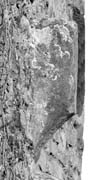
Object type: Part of a prokrossos
Measurements: H. 50 cm (19.7 in) at wall; 34 cm (13.4 in) at broken face; W. 31.5 cm (12.4 in) at wall; 27 cm (10.6 in) at broken face; D. 17 cm (6.7 in)
Stone type: Greyish orange (10YR 7/4) grain supported shelly, spar cemented oolite with many hollow grains. Ooliths range in size from 0.2 to 0.8 mm. Shells mainly 2 mm but some up to 8 mm. Bedding vertical. Cleeve Cloud Member, Birdlip Limestone Formation, Inferior Oolite Group, Middle Jurassic.
Plate numbers in printed volume: Ills. 188-90, 199
Corpus volume reference: Vol 10 p. 181
(There may be more views or larger images available for this item. Click on the thumbnail image to view.)
In situ. It seems probable that the animal head was intact until the restoration of 1861–2 (see below). Noted in present position by Haigh (1846, 17) and Butterworth (1862, 97). Unfortunately this part of the church is shrouded in vegetation in the one photograph known from before the major restoration of 1861–2 (Knowles 1927, pl. XIII (fig. 1)). In 1890 Butterworth wrote that 'long ago he lost his head, and remains a mere wreck of his former self'; in 1891 he refers to 'decapitation' as having been 'mischievously performed' (Butterworth 1890, 77; id. 1891, 10–11). It is clear from internal references that Butterworth's article of 1862 went to press before the restoration of 1861–2 was finished, and the most likely scenario is that this prokrossos sustained damage during the latter stages of the restoration.
The neck alone now remains of this animal head, although two nineteenth-century records appear to imply that the head was substantially complete as late as 1862. Haigh describes it as 'a monstrous head projecting from the wall' (Haigh 1846, 17), while Butterworth describes it as 'the large head of a whale, or other monster of sea, air, or land' (Butterworth 1862, 97). The surviving portion of the neck is rounded in cross section, similar to the prokrossos above the west door (no. 9).
So little survives of this prokrossos that it is not possible to say more than that the rounded neck suggests that it was similar to the lower western prokrossos (see above).
See Deerhurst St Mary 13 for a general discussion of the animal-head carvings.
