Select a site alphabetically from the choices shown in the box below. Alternatively, browse sculptural examples using the Forward/Back buttons.
Chapters for this volume, along with copies of original in-text images, are available here.


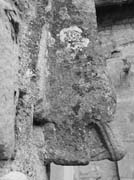
Object type: Animal-head label stop
Measurements: H. 20.5 cm (8 in) at wall; W. 6 cm (2.4 in) at hood-moulding and ear tips; 7.5 cm (2.9 in) at brow; 4.6 cm (1.8 in) at muzzle; D. 8.7 cm (3.4 in) at hood-moulding and ear tips; 10.6 cm (4.2 in) at brow
Stone type: Yellowish grey (5Y 8/1) matrix supported shelly, spar cemented oolite. Shell clasts sparse. Ooliths 0.6 to 1 mm in size. Cleeve Cloud Member, Birdlip Limestone Formation, Inferior Oolite Group, Middle Jurassic.
Plate numbers in printed volume: Ills. 195-9; Fig. 26C
Corpus volume reference: Vol 10 p. 182-3
(There may be more views or larger images available for this item. Click on the thumbnail image to view.)
Animal-head label stop carved integrally with the hood-moulding. The head is twisted slightly inwards, thus bringing the hood-moulding to an end on a slightly accentuated curve. The stone has been subject to more weathering than its eastern pair (Deerhurst St Mary 16) and much less of the surface decoration can be readily seen. However enough has survived to indicate that this head was carved with a similar scheme of incised decoration to that of no. 16 and the animal heads from the west end of the church (nos. 13 and 14). The muzzle rises to a brow ridge that is similar to no. 16, but above the brow ridge the plain forehead is divided into two by a deeply incised vertical line. The creature's eyes are also similar to nos. 13, 14 and 16, and on the east side of the head it is still possible to make out the brow ridge sweeping down to what is probably a down-turning spiral terminal. Most of the back of the eye on the west side of the creature's head, together with the brow ridge and terminal, has been lost as a result of surface damage. The creature's nose is long and the nostrils are lightly incised. The jaws are wide open. The upper fangs are large, well-defined and carved in high relief on the side view and the open-mouth (face F) view. On the west side of the head the lower fang is also carved in high relief, while on the eastern side the lower fang is carved in lower relief. The rest of the creature's teeth are cut back a little from the face, and some indentation survives that might indicate that the teeth were individually differentiated. The inside of the mouth is further cut back by about 0.3 cm (0.1 in). The ears are flattened back along the neck, and the surrounding stone has been cut back around them to leave them about 0.3 cm (0.1 in) proud of the head and neck. They lie side by side and are shaped like hollowed-out, tear-drop forms that are drawn up into out-turning, comma-like tips. There is no crest between the creature's ears. The straight sides and flat front face of the hood-moulding rise undifferentiated from the tips of the ears and the sides of the creature's head.
See Deerhurst St Mary 13 for a discussion of the group of six animal heads: nos. 13–14, and 16–19.
