Select a site alphabetically from the choices shown in the box below. Alternatively, browse sculptural examples using the Forward/Back buttons.
Chapters for this volume, along with copies of original in-text images, are available here.


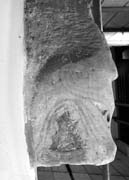
Object type: Animal-head label stop
Measurements: H. 43 cm (16.9 in); W. 16 cm (6.3 in) at crest; 18 cm (7 in) across brow below ears; 14 cm (5.5 in) at muzzle; D. 17 cm (6.7 in) at crest; 23 cm at brow; 20 cm (7.9 in) at muzzle
Stone type: Yellowish grey (5Y 8/1) matrix supported muddy oolite. Ooliths solid and ranging in size from 0.2 to 0.8 mm. Cleeve Cloud Member, Birdlip Limestone Formation, Inferior Oolite Group, Middle Jurassic.
Plate numbers in printed volume: Ills. 200-5; Figs. 26E, 36; Colour Plate 1
Corpus volume reference: Vol 10 p. 183-4
(There may be more views or larger images available for this item. Click on the thumbnail image to view.)
In situ. Noted in present position by Haigh (1846, 17) and Butterworth (1862, 95) and visible in a drawing made during the restoration of 1861–2 (Strickland 1862).
Painted animal-head label stop to the north side of the blocked chancel arch, carved as one with the first section of the hood-moulding which is 14 cm (5.5 in) wide and 13 cm (5.1 in) deep. The head is twisted slightly to the south, continuing and slightly accentuating the general curvature of the hood-moulding. The top of the creature's head is broad and quite long, the forehead tapering between the eyes to form the bridge of a squarish muzzle. The jaws are open and full of teeth. There is a faint, incised setting-out line down the central element of the crest or mane. The essential structure of the head was blocked out, like the paired animal head to the south of the arch (Deerhurst St Mary 19), but (unlike the southern head) the ears, eyes and nostrils together with the crown of the head were then further accentuated by being carved more deeply. The muzzle curves up from the flaring, hollowed-out nostrils to well-defined brow ridges over the eyes. Above the brow ridges the forehead is divided in two by a vertical groove that continues the line of, but does not quite meet, the setting-out line observed on the animal's crest. The eyes are long, rather almond-shaped, V-profile cuts that are drawn out backwards into narrow points where they curve around the sides of the head. The pupils are circular and deeply cut with sharp, straight-sides. The teeth and huge fangs are carved in low relief on the sides of the jaws, but the open mouth (face F) is flat with no relief carving at all. The creature's ears lie flat on the top of the head with their in-curling tips across the lower part of the crest or mane. The overall shape of the ears is rounded at the bottom and sharply pointed at the top. The inside of each ear is split into two compartments, a circular, concave lower area with a sub-triangular, V-profile area above. The crest or mane on the top of the head consists of three flat elements divided by incised lines. The central tapering, round-topped element is flanked by two larger, folded-over, comma shapes. Unlike the two animal heads on the western door (Deerhurst St Mary 13 and 14), the crest or mane is not carried back along the sides of the creature's head. Both side faces (faces B and D) of this animal head are dominated by the creature's open jaws and by the spiral terminals to the brow ridges.
The concentric lines and enhancement of details that are incised on the faces of four of the other animal heads at Deerhurst (nos. 13, 14, 16, 17) are not incised on this head but instead they are painted in beautifully controlled red lines. Three concentric lines sweep across the muzzle, bending downwards between the creature's nostrils. The eyes and ears are outlined in red line and the brow ridges are accentuated with sweeping red line (colour frontispiece, Plate 1). On both sides of the creature's head the brow ridge and the back of the eye are drawn out into an exceptionally large, double-line spiral terminal, while the jaw is outlined with a double red line. The medium used is iron oxide red, and this was also used to paint the inside of the open jaws and the nostrils, pupils and ears. An overall wash of iron oxide yellow was then applied to the head, over a carbonate white ground in some areas such as the eyes. The centres of the pupils of the eyes were further enhanced with charcoal black. (See Chapter X for a detailed summary of the Deerhurst polychrome, and Gem et al. 2008 for a fuller analysis.)
The survival of a significant amount of the original ninth-century scheme of painting on this animal head offers a very rare opportunity to appreciate just how dramatic much Anglo-Saxon carving must have been. With the exception of the three elements of the crest or mane, which on this head are large and rather crude, the overall decorative repertoire is very similar to most of the other animal heads from this church (see Deerhurst St Mary 13 for a discussion of the group of six animal heads: nos. 13–14, 16–19). Enough survives of the painted scheme to permit accurate frontal and side view reconstructions to be made (faces A and B), while the recording of surviving areas of paint on the voussoirs and hood-moulding of the chancel arch (first noted by Bagshaw in 2002 (Bagshaw et al. 2006, 85)), together with newly discovered fragments of a painted spiral volute plant-scroll on the voussoirs, has enabled a reconstruction of the whole of the chancel arch scheme to be attempted (Gem et al. 2008, 130–9, figs. 24–6, 42–5).
