Select a site alphabetically from the choices shown in the box below. Alternatively, browse sculptural examples using the Forward/Back buttons.
Chapters for this volume, along with copies of original in-text images, are available here.


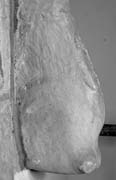
Object type: Animal-head label stop
Measurements: H. 47 cm (18.5 in); W. 16 cm (6.3 in) at 'crest'; 18 cm (7 in) across brow below ears; 15 cm (5.9 in) at muzzle; D. 14 cm (5.5 in) at 'crest'; 22.5 cm (8.8 in) at brow; 19.6 cm (7.7 in) at muzzle
Stone type: Greyish yellow (5Y 8/4) matrix supported muddy oolite. Ooliths solid and ranging in size from 0.2 to 0.8 mm. Cleeve Cloud Member, Birdlip Limestone Formation, Inferior Oolite Group, Middle Jurassic.
Plate numbers in printed volume: Ills. 206-10; Figs. 26F, 36
Corpus volume reference: Vol 10 p. 184-5
(There may be more views or larger images available for this item. Click on the thumbnail image to view.)
Animal-head label stop to south side of blocked chancel arch. The head is about 4 cm (1.6 in) longer than its northern partner (Deerhurst St Mary 18), but in all other dimensions the heads are virtually identical. However, most of the additional height/length is in the muzzle and this, together with the lack of surface decoration, makes the head appear sharper and finer than that of the northern animal. The lack of paint also makes it easier to see the smoothed, almost burnished surface finish given to the stone. This level of surface finish is apparent on several of the Deerhurst carvings (for example the Virgin-and-Child carving at the west end of the church (no. 5) and the triangular-headed painted panel (no. 7) that is set high in the east wall of the church (Bagshaw et al. 2006, 69). The head is twisted slightly to the north, continuing and slightly accentuating the general curvature of the hood-moulding. The main structural features are blocked out with flaring nostrils, sweeping brow ridges and two elongated ears with slightly in-curving tips. The top of the head, between the ears, is a straight edge above which the crest area is defined by a simple rectangular panel set back slightly from the top of the head. There is a further shallow set-back from the top of the crest area to the face of the hood-moulding. The forehead is divided into two by a shallow, vertical groove. No attempt has been made to hollow out the centres of the ears and nostrils (with the exception of a small, rather random hole chipped into the centre of the left nostril) and the eyes are not defined at all.
Traces of iron-oxide red and iron-oxide yellow paint have been identified on the head but no details of the decoration have survived apart from the faintest indications of teeth and fangs painted in red, together with larger areas of red paint especially in the shallow, cut-back area of the open mouth on the south side of the creature's jaw.
The analysis of the surviving traces of iron-oxide red and iron-oxide yellow paint indicate that the head is contemporary with its northern partner and that it was once similarly painted (Gem et al. 2008). It is not possible to say why this head was treated so differently to Deerhurst St Mary 18, but the treatment is similar to the contemporary prokrossos and animal heads on the high-level doorway in the porch/tower (nos. 10–12) and to the Virgin-and-Child panel at the west end of the church (no. 5). Once painted, the two animal heads would have been virtually indistinguishable from more than a few metres away.
(See Deerhurst St Mary 13 for a discussion of the group of six animal heads: nos. 13–14, 16–19.)
