Select a site alphabetically from the choices shown in the box below. Alternatively, browse sculptural examples using the Forward/Back buttons.
Chapters for this volume, along with copies of original in-text images, are available here.


Object type: Part of cross-shaft
Measurements: H. 73 cm (28.7 in); W. 34 < 36 cm (13.4 < 14.1 in); D. unknown
Stone type: Greyish pink (5R 8/2), hard, fairly well sorted fine to medium-grained sandstone. Mainly quartz in angular to sub-angular grains (0.2 to 0.5 mm) along with some mica. Signs that the stone has been painted. Possibly Clee Sandstone Formation, Woodbank Group, Lower Old Red Sandstone (Lower Devonian) or Farlow Group, Upper Old Red Sandstone (Upper Devonian).
Plate numbers in printed volume: Ills. 543-4; Fig. 30G
Corpus volume reference: Vol 10 p. 307
(There may be more views or larger images available for this item. Click on the thumbnail image to view.)
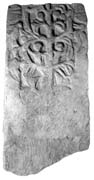
Lower part of shaft with inhabited tree motif. Branches sprout from either side of the straight central stem/trunk. The leaves are lush and heavy and some have hollowed centres. From the leaves grow rounded, straight-stalked fruit. Two human figures are caught in the act of climbing the tree for the fruit. To the left of the tree, above the head of one of the figures, is a bird with flapping wings, also trying to eat the fruit. There is a rather worn area of carving on the opposite side of the tree that might be a second bird perched on a branch. The lower 30 cm (11.8 in) of the stone is uncarved.
The liveliness of the carving on this tree-scroll is reminiscent of earlier west Mercian carvings, for example the late eighth-century cross from St Oswald's, Gloucester (no. 1, p. 207, Ills. 265–9) and the ninth-century tree-scrolls on Gloucester St Oswald 3 and Newent 1, also Gloucestershire (p. 209, Ill. 281; p. 232, Ill. 396). Straight-stalked fruit and hollow leaves can be found on ninth- and tenth-century pieces, but some of the detailing on this Diddlebury shaft is more like tenth-century work. This is especially true of the rather stilted human figures, who might be Adam and Eve caught in the act of trying to get the apple. Alternatively, since both figures are in the tree and have their arms raised, they might instead be depictions of more ordinary people trying to scare birds away from the ripening crop of fruit. It has been suggested that Diddlebury was probably a minster church (Croom 1988, 72).
