Select a site alphabetically from the choices shown in the box below. Alternatively, browse sculptural examples using the Forward/Back buttons.
Chapters for this volume, along with copies of original in-text images, are available here.


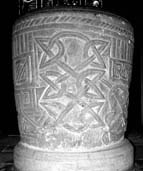
Object type: Font 1
Measurements:
H. 68.5 cm (27 in); W. (external diam.) c.74 cm (29 in);
Font bowl: W. (internal diam.) c.46 cm (18.1 in); D. c.30 cm (11.8 in)
Stone type: Yellowish grey (5Y 8/1, hard, well sorted, very fine to medium-grained (0.1 to 0.3 mm) sandstone. Grains mainly quartz but with a scattering of a dark green mineral, probably glauconite, grains sub-angular to rounded. Wrekin Quartzite Formation, early Cambrian.
Plate numbers in printed volume: Ills. 744-6
Corpus volume reference: Vol 10 p. 384
(There may be more views or larger images available for this item. Click on the thumbnail image to view.)
This tub-shaped font has a double moulding (cable above plain) just below the rim. The rest of the face is covered with four rows of large motifs carved in shallow relief. The uppermost row consists of close-set vertical rectangles. Below this is a row of squares and rectangles, each of which consists of a pair of triangles joined along the long sides. Below this there is a zone of simple, angular, median-incised interlace, one end of which loops back on itself while the other end finishes with two decorated squares linked by a wide meander border around a narrow band of diagonal hatching. The lowest zone of carving consists of an angular plant-scroll from which most of the leaves have become detached. On what is probably the front of the font this scheme of decoration is replaced with a panel that is the full height of the font and covered with median-incised, mirror-image interlace that rises through three tiers of angular, opposed knots. A small hatched lozenge is inscribed into the centre of the uppermost tier of interlace.
Appendix K item (Fonts and stoups in the Western Midlands).
The paired triangle motif is a simple form of diagonal fret similar to that found on the South Cross at Castledermot, Co. Kildare (Crawford 1980, 35, pls. xxvii, xxviii; this volume, Ill. 784). Diagonal fret is also used in Insular manuscripts, for example on the canon table page, fol. 17b of the Lindisfarne Gospels (British Library, MS Cotton Nero D. IV: Backhouse 1981, 39, ill. 22). As at Bucknell (see below, p. 390), this motif and all of the other design motifs are pre-Conquest in nature but the font should probably be seen as an example of Saxo-Norman overlap carving.
[1] There are, beside the Deerhurst font in Gloucestershire which has been shown to be of ninth-century date (Deerhurst St Mary 3, p. 163, Ills. 132–44, 740), a number of fonts in the study area that have been said to be Anglo-Saxon or could be Anglo-Saxon. There are also objects like Bisley All Saints 6 (below, Ills. 732–4) that has been described as a font fragment, and Kenchester 1 (p. 382, Ills. 735–6) that now functions as a font, but that are much smaller than all of the other vessels and may, therefore, have originally been used as stoups or lavabo bowls (see below, and 'Further thoughts on fonts' in Chapter V, pp. 62–4, Table 1). In the following Appendix three vessels that were probably stoups have been listed first, followed by the fonts in chronological order by form (cylindrical tub fonts, square tub fonts, tapering or cone-shaped fonts, and bowl-shaped fonts). Some clearly belong to the Overlap period but are included because they show continuity of form and decoration into the later decades of the eleventh century and beyond.
The tub font at Deerhurst is the earliest securely datable font, and an eighth-century Anglo-Saxon ivory panel in the Victoria and Albert Museum that depicts the baptism of Christ also show a tub font (Beckwith 1972, 119, cat. 5, ill. 20). Tub fonts have, therefore, been placed first in the catalogue below. However, in the south-west of England the earliest surviving fonts are bowl-shaped (copies of domestic bowls) and it seems inherently likely that both tubs and bowls were in use at the same time (Cramp 2006, 38; Blair 2010).
Many of the western Midlands fonts seem to have been carved from newly worked stone, but several are carved into reused Roman capitals and bases. One of the reused Roman bases (at Woolstaston, Shropshire), almost certainly came from the Roman city of Viroconium (Wroxeter) but, unlike the similarly reused bases at Wroxeter St Andrew and Shrewsbury Abbey (pp. 390, 389, Ills. 762–3, 768–70), this vessel has been very crudely reshaped and the bowl is only 8 cm deep (p. 386, Ills. 756–7). It does not look like a font at all but it would, in fact, be ideal for the baptism of adults by affusion or aspersion. Adult baptism must have been very rare by the later Anglo-Saxon period, so it seems possible that the Woolstaston font might be very early, perhaps even sub-Roman.
