Select a site alphabetically from the choices shown in the box below. Alternatively, browse sculptural examples using the Forward/Back buttons.
Chapters for this volume, along with copies of original in-text images, are available here.


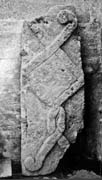
Object type: Grave-cover
Measurements: H. 137 cm (53.8 in); W. 52 > 42.8 cm (20.4 > 16.8 in); D. 14 cm (5.5 in)
Stone type: Yellowish grey (5Y 7/2) shelly oolite with sparry matrix with dark coloured intraclasts. Possibly recrystallised. Ooliths around 0.6 mm and intraclasts 0.6 to 0.8 mm. Stone laminated parallel to grave slab. Possibly White Limestone Formation, Great Oolite Group, Middle Jurassic.
Plate numbers in printed volume: Ill. 469
Corpus volume reference: Vol 10 p. 260
(There may be more views or larger images available for this item. Click on the thumbnail image to view.)
A pencil drawing in the Romilly Allen collection is labelled 'Slab dug up in Elkstone Ch.Yd' and bears the date April 27, 1885; it is not entirely clear whether this is the date of the drawing or of the discovery (British Library, Add. MS 37550, no. 504).
Tapering grave-cover with relief carving in which the background has been cut-back by 2 cm (0.8 in). The carving takes the form of a large lozenge surrounded by 7 cm (2.8 in) wide, flat borders. At the top of the stone the borders continue diagonally above the lozenge to finish in the upper corners of the stone in opposed, inward-pointing, spiral-hooked terminals. Below the central lozenge the borders are crudely interlaced in a single plait before continuing diagonally to the bottom corners of the stone where they finish as opposed, outward-turned, spiral-hooked terminals (one of these terminals has been lost due to damage to that corner of the stone).
Appendix A item (stones dating from Saxo-Norman overlap period or of uncertain date).
This unusual grave-cover is similar in some respects to the group of gravestones from Stedham and Steyning in Sussex which have raised median ridges that bifurcate at either end. The Steyning example also has small incised lozenges on the median band. These gravestones are difficult to date, but Tweddle relates them to similar stones from Cocking and Chithurst in Sussex, Milton Bryan in Bedfordshire, and to early to mid eleventh-century examples from East Anglia (Tweddle et al. 1995, 193–5, 197–8, 232, ills. 237, 241, 245, 250, 361).
