Select a site alphabetically from the choices shown in the box below. Alternatively, browse sculptural examples using the Forward/Back buttons.
Chapters for this volume, along with copies of original in-text images, are available here.


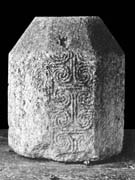
Object type: Part of cross-shaft
Measurements: H. 70 cm (27.5 in); W. 57 cm (22.4 in); D. 53.5 cm (21 in)
Stone type: Yellowish grey (5Y 8/1) sparsely oolitic very shelly limestone. The matrix appears sparry and commonly supports the shell debris. The ooliths are commonly hollow and range in size from 0.2 to 0.6 mm. The shell debris consisting of bivalve, brachiopod and gastropod fragments is up to 10 mm in size. Bedding seen on the poorly ornamented side is vertical up and down the cross-shaft. The stone shows the patchy remains of a white coating (?limewash) which contains abundant fine grained sand (grains c. 0.2 mm). Crickley Member, Birdlip Limestone Formation, Inferior Oolite Group, Middle Jurassic. This stone appears to be made of the same material as the bowl and stem of the Deerhurst St Mary font (no. 3, p. 163), but it is less weathered than the Deerhurst examples and paler in colour.
Plate numbers in printed volume: Ills. 242-7; Fig. 42
Corpus volume reference: Vol 10 p. 198-201
(There may be more views or larger images available for this item. Click on the thumbnail image to view.)
None. First mentioned in 1886 (Browne 1884–8, ciii), and perhaps discovered during the restoration of the church in 1871–8 (Verey and Brooks 2002, 356–7; Hare 2010, 135)
Part of a spiral-decorated cross-shaft cut down to a rather irregular octagon in plan and chamfered off around a socket at the top, probably to form a cross-base. The socket is 23 cm (9 in) square and 15 cm (5.9 in) deep and it is probably a later adaptation rather than an original feature of the stone. Three faces (A, C and D) carry the remains of interlocking, opposed 'C-curve spiral' carving in shallow relief. The spirals and straight linking lines are even in width, with no swelling as is found in trumpet scrolls and pelta, and the term 'bracketed-spiral' is used below as a clearer description of the motif. The fourth face (B) bears heavy diagonal tooling. The other four faces of the shaft (the later re-cut corner faces) are finely tooled, with one showing signs of being rather crudely re-trimmed across the lower part of the face with a broad-bladed axe or chisel. The socket in the top of the stone is placed centrally on the A–C axis, but slightly off-centre on the present B–D axis.
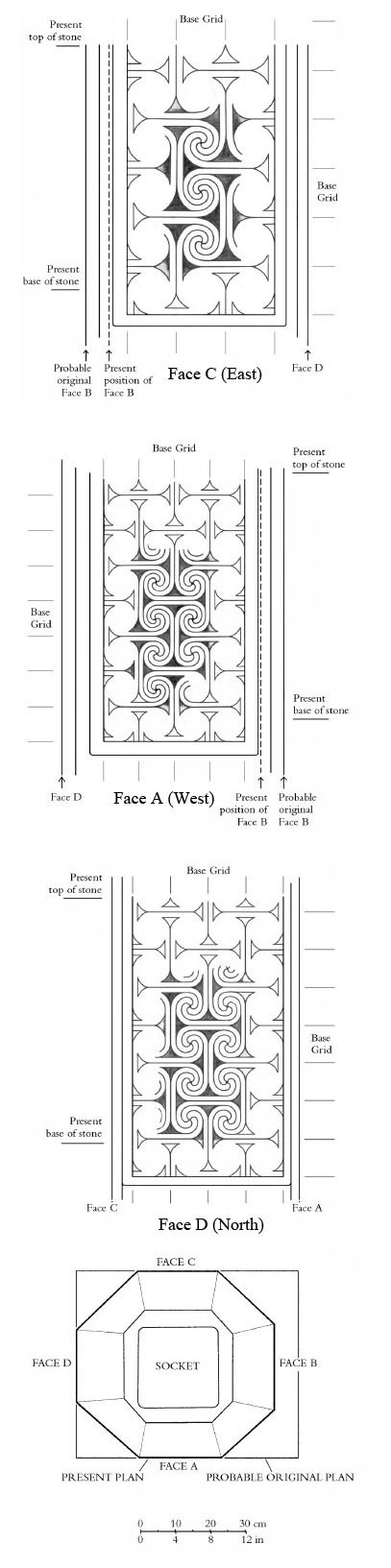
Enough of the carved detail survives on faces A, C and D to allow reconstructions of the full widths of these panels (see below and Fig. 42). Assuming that the panels were centred on each face, it is possible to suggest that 6.7 cm (2.6 in) has been lost from face B which would be more than enough to remove any carved decoration. If this assumption is correct, the original plan section of the shaft can be reconstructed as a rectangle 63.7 x 53.5 cm (25 x 21 in). The carving is set out on square base-grids which are of different sizes on each of the decorated faces, and the original width of each decorative panel can be reconstructed with accuracy (see Fig. 42). The carving on face A (which presently faces west) was based upon a 10.1 cm (4 in) square grid, laid out as two double columns of squares and was originally 40.4 cm (c. 16 in) wide. On face C the carving was based upon a 14 cm (5.5 in) square grid, laid out as a column of three squares and was 42 cm (16.5 in) wide. On face D the carving was based upon a 10.8 cm (4.25 in) square grid, laid out as two double columns of squares and was 43.2 cm (c. 17 in) wide. The identification of the base-grid units for the carving also shows that, to allow the design to be completed, the carving would either have had to run across the joint between the present stone and other stones that were originally set below and above it; or that c. 9 cm (3.5 in) has been lost from the bottom of the present stone and at least 7 cm (2.8 in) from the top. The smaller base-grid unit used on face A, which would have resulted in a finer and denser pattern, might indicate that this was originally the principal face of the shaft. On each face there was room on either side of the decorative panels for borders and edge moulding. Assuming that care was taken to try to centre the designs on each face, it is possible to suggest that each panel was surrounded by a plain border set within double edge-mouldings on the wider faces (A and C) and within single edge mouldings on the narrower faces (D and probably B). It will be seen (Fig. 42) that the suggested borders and side mouldings vary a little in width to accommodate small discrepancies in the setting out, and that those on face D are narrower that those on faces A and C.
| Fig 43 |
| Bracketed C-spiral decoration on Faces A, C and D of the cross-shaft fragment from Elmstone Hardwicke (1). The plan view shows the present, irregular octagonal shape and the probable original rectangular shape. The socket cut into the top of the stone is probably from a later reuse. The faces show the surviving areas of carving, with the full design reconstructed in outline. Each face was constructed upon a different base grid, with the largest (14 cm/5.5 in) on Face C and the smallest (10.1 cm/4 in) on Face A. It is suggested that each decorative panel was surrounded by a plain border set within double edge-mouldings on the wider faces (A and C) and a single edge moulding on the narrower faces (D and probably B). The suggested borders and side mouldings vary a little in width (Elmstone Harwicke 1) |
The carving on the Elmstone Hardwicke stone has long been compared with that on the font at Deerhurst (Deerhurst St Mary 3a–b, Ills. 132–44), less than three miles away to the north-west, and much of the detailed discussion that follows is the same as for the font (see for example Hudd 1886–7, 100–2). The 'bracketed-spiral' motif that is used in densely packed panels on both is rare in Anglo-Saxon sculpture and found nowhere else in Gloucestershire or in western Mercia. Related designs are found in eastern Mercia, for example the panel of trumpet-spirals arranged in pelta pattern (together with single spirals described as leaf-whorls and set within a running spiral scroll) at Breedon-on-the-Hill in Leicestershire (Jewell 1986, 96–7, 103, pls. XLII, L). A second 'complex field of trumpet-spirals ... based around a triskele of three rounded forms' survives with other fragments of a panel or group of panels at South Kyme in Lincolnshire (Everson and Stocker 1999, 249, ills. 339, 343). The Breedon friezes are dated to the early ninth century, and the South Kyme panel to the late eighth or early ninth century. One of the carved whale's bone panels on the side of the Anglo-Saxon Gandersheim casket shows a triple triskele pattern of trumpet scrolls, and is dated to the late eighth century (Webster and Backhouse 1991, 177–9, ill. 138). Hiberno-Saxon manuscripts of the eight century abound with spirals, trumpet-scrolls and pelta. Examples occur on the miniature of King David and Musicians in the Vespasian Psalter, fol. 30v, and St John from the Codex Aureus, fol. 150v, both dated to the mid eighth century (Alexander 1978, 55–7, ills. 146, 147), but, as with most of the painted manuscript motifs, the designs are more curved and flowing, less regimented than the Gloucestershire carved examples. In this respect the decoration on both Elmstone Hardwicke and the Deerhurst font is closer in concept to panels on some of the ninth-century Irish high crosses, for example, the South Cross, Castledermot (Co. Kildare) and the Kinnitty Cross (Co. Offaly). However, the closest parallel for both the straight-backed, 'bracketed-spiral' form and the densely packed overall design is probably the very worn eighth-century panel from Bradford-on-Avon, Wiltshire (Cramp 2006, 205, ills. 407–9).
In his discussion of the Anglo-Saxon sculptures from Deerhurst, from which several of the comparative examples above have been taken, Bailey suggested that the combination on the font of the 'bracket-spiral' panels with panels containing knotwork that terminates in confronted animal heads, and borders with foliate and fruiting spiral scrolls, would support a date for the carving in 'the period around the beginning of the ninth century' (Bailey 2005, 17–21). Elsewhere in this volume (see Deerhurst St Mary 3a–b, p. 166), the present author supports the view that the font should be seen as part of a coherent body of work at the church dating from the first half of the ninth century. The very close similarity between the decoration indicates that the Elmstone Hardwicke shaft must be of the same date. Furthermore, the type of stone from which the Elmstone Hardwicke shaft and the bowl and stem of the Deerhurst font have been carved is very distinctive. Geological analysis indicates that all three stones come from a specific bed within the Inferior Oolite (the Crickley Member in the Birdlip Limestone Formation). This stone has not been used for any of the other Anglo-Saxon carving from Gloucestershire, and the identification lends further support to the contemporaneity of the pieces. However, despite exhaustive attempts to reconstruct all three stones into one original monument, the pieces resolutely refuse to fit together. Indeed, detailed cross-sections and plans indicate that none of the pieces fit together. Even the apparent close fit between the bowl of the font and the present stem is in part due to damage that has removed part of one side of the bowl (see discussion of the Deerhurst St Mary 3 font and Fig. 40). Although the present, cut-down, octagonal shaft at Elmstone Hardwick would fit on top of the stem of the font, when the dimensions of the shaft are reconstructed (see Description above) to allow for the loss of the original face B together with the missing areas down either side of each of the decorative panels, the Elmstone Hardwicke shaft is too wide, corner to corner, to fit on top of the font stem, and too narrow if measured between faces A and C to fit under the stem. It is not even possible to suggest that the corners of the shaft might have been chamfered to give a rather irregular octagonal plan, because the minimum widths of the panels of decoration mean that the resulting shape would still be too big to fit within the circumference of the Deerhurst font stem. Therefore, with a slight sense of unreasonable sadness, the author acknowledges that it has not proved possible to put together the Elmstone Hardwicke and Deerhurst font stones as component parts of a magnificent lost high cross. Instead, it is suggested that the Elmstone Hardwicke stone is contemporary with, but separate from, the stones of the Deerhurst font and that it is part of a cross-shaft that perhaps always stood at Elmstone Hardwicke.
The name Elmstone would seem to derive from 'Æthelmund's stone'. One of the patrons of nearby Deerhurst at the beginning of the ninth century was called Æthelmund, in all likelihood the ealdorman of that name killed in battle with the men of Wiltshire in 802. In the light of the similarity between the carving of this stone and the font at Deerhurst, it has recently been proposed that the cross of which this stone formed part was erected either by Æthelmund or more probably to commemorate him after his death in battle; the cross is in turn argued to have given its name to the settlement. This line of thought is developed in more detail in Hare 2010. The precise reasons for the choice of what seems to have been an isolated place remain unclear. When first recorded in the thirteenth century, Elmstone Hardwicke church was a chapelry of Deerhurst (Elrington 1968, 58), and it is argued by Hare (2010, 146–8) that it was in Deerhurst's minster parochia from the outset.
