Select a site alphabetically from the choices shown in the box below. Alternatively, browse sculptural examples using the Forward/Back buttons.
Chapters for this volume, along with copies of original in-text images, are available here.


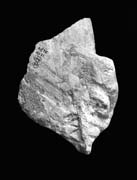
Object type: Small animal-head label stop
Measurements: H. 17 cm (6.7 in); W. 6.8 cm (2.7 in); D. of beast head c. 7.3 cm (2.9 in); of whole stone 12.8 cm (5 in)
Stone type: Very pale orange (10YR 8/2), grain supported oolite with micritic matrix. Hollow ooliths sparse (0.2 to 0.5 mm). Sparse shell debris 2–3 mm. Cleeve Cloud Member, Birdlip Limestone Formation, Inferior Oolite Group, Middle Jurassic.
Plate numbers in printed volume: Ills. 326-9; Fig. 29J
Corpus volume reference: Vol 10 p. 218
(There may be more views or larger images available for this item. Click on the thumbnail image to view.)
The animal head has very pronounced, bulbous eyes that are drawn out around the sides of the head. The pupils are drilled. The muzzle is heavily grooved to simulate a snarl that exposes a mouthful of sharp, triangular-shaped teeth. The brow is square and above it are the remains of a simple roll that presumably decorated the hood-moulding to which the head acted as a terminal.
The eight animal-head label stops that are to be found at Deerhurst in Gloucestershire are dated to the first half of the ninth century (see pp. 176–85, Deerhurst St Mary 11–14, 16–19). Most of the Deerhurst animals are snarling, open-mouthed creatures (Ills. 165–87, 191–210), and this small animal head (St Oswald 18) is clearly in that tradition. It is also similar to an animal head found during excavations in 1978–9 at St Mary de Lode in Gloucester (Gloucester St Mary de Lode 2, Ills. 259–60), which is dated to the mid ninth century (see p. 206). Gloucester St Oswald 18 could, therefore belong to the first phase of building at St Oswald's in the tenth century (see also Appendix A, p. 260, Gloucester St Oswald 27 discussion).
