Select a site alphabetically from the choices shown in the box below. Alternatively, browse sculptural examples using the Forward/Back buttons.
Chapters for this volume, along with copies of original in-text images, are available here.


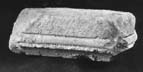
Object type: Part of an abacus
Measurements: H. 9.5 cm (3.7 in); W. 27.5 cm (10.8 in); D. 14.7 cm (5.8 in)
Stone type: Yellowish grey (5Y 8/1) micritic matrix supported oolite with very small amount of shell debris. Ooliths mainly around 0.2 mm. Internal texture obscured. Possibly Cleeve Cloud Member, Birdlip Limestone Formation, Inferior Oolite Group, Middle Jurassic.
Plate numbers in printed volume: Ills. 330-3; Fig. 21C
Corpus volume reference: Vol 10 p. 218-9
(There may be more views or larger images available for this item. Click on the thumbnail image to view.)
Part of an abacus that is slightly rhomboid in plan. The profile on two faces consists of a broad, flat surface below which is a shallow concave moulding defined along both upper and lower edges by a fairly sharp groove. The lower part of the abacus is cut back into a shallow chamfer.
Three abacus fragments of similar profile were found during the excavations. While two (Gloucester St Oswald 19 and 21) were unstratified, one (St Oswald 20) was reused c. 1120 at the rebuilding of the church which involved the demolition of the Anglo-Saxon east porticus. The profiles, especially of nos. 19 and 20, are very similar to the abaci of the columns in the crypt at Repton, Derbyshire. These have been attributed to the mid ninth century (Biddle 1986, 16–22). A fragment with similar mouldings to these abaci (Gloucester St Oswald 22, Ills. 344–5) had been reused by the eleventh century. The St Oswald's abaci could, therefore, be early tenth century and belong to Period I or II in the development of the church.
